Choose an AI service. ChatGPT and Perplexity submit the summary request, Grok opens it ready to send, and other services open with the request copied as a fallback. If an AI cannot open the page, copy the article text and paste it into the chat.
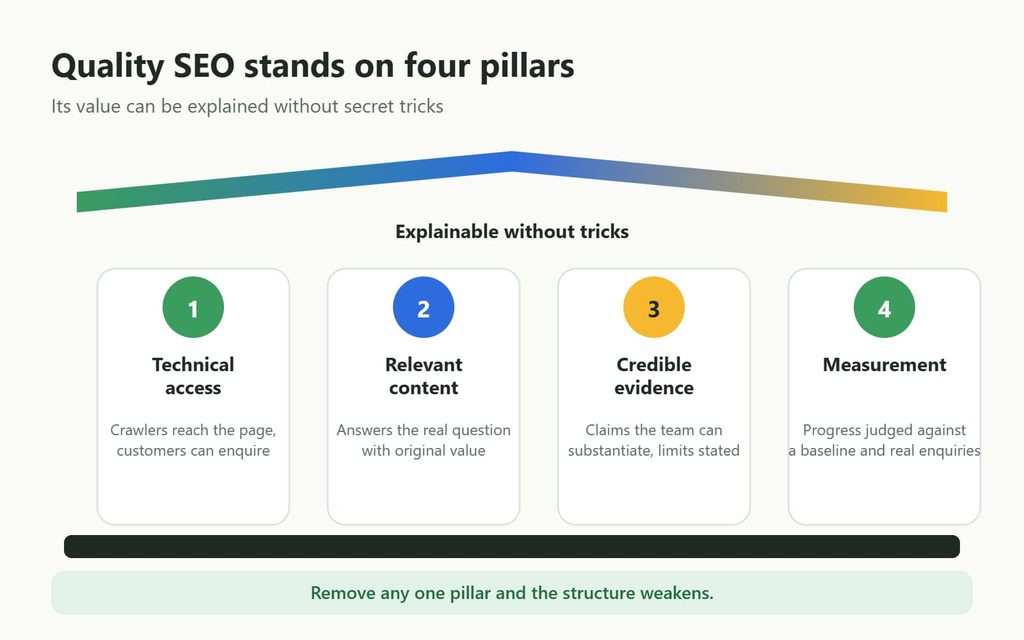
Quality SEO helps search systems discover and understand useful information, while helping customers decide whether a business meets their needs. It combines technical access, relevant content, credible evidence and measurement. Its value should be explainable without referring to secret tricks.
A poor experience with a provider is a reason to examine the work and its claims carefully. Ask what will change, why it matters and how progress will be assessed before committing to a campaign.
What does SEO manipulation mean?
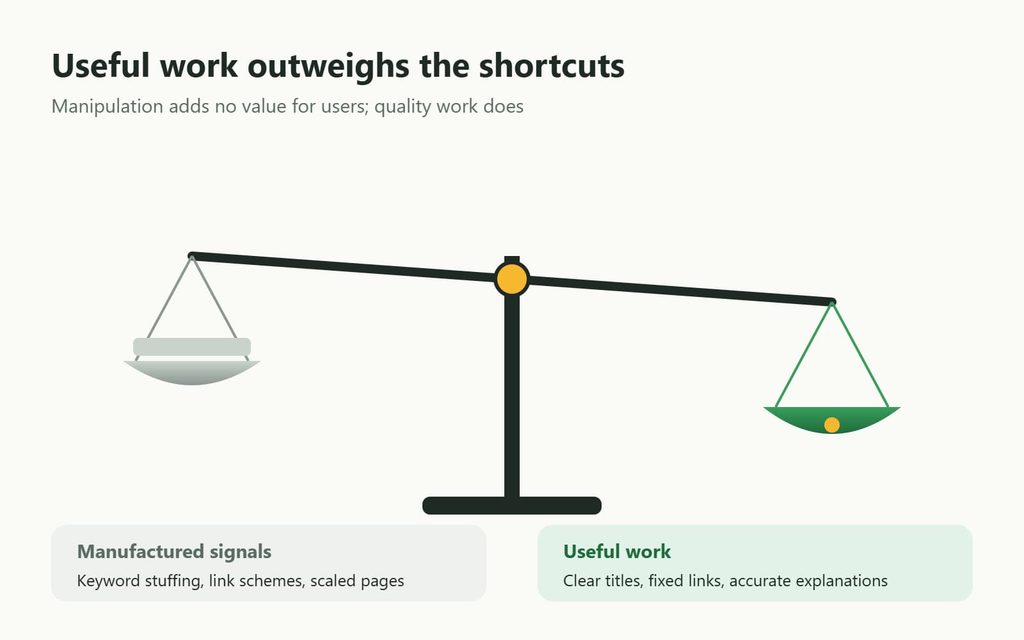
The phrase usually describes attempts to manufacture ranking signals or deceive systems without providing corresponding value to users. Examples include keyword stuffing, link schemes and pages created at scale primarily to manipulate search rankings.
Optimising a clear title, fixing a broken internal link or explaining a service more accurately is different work. The purpose is to make a useful page accessible and understandable. Our guide to white-hat SEO explores how to assess tactics against search policies and customer value.
Google uses multiple ranking systems and signals, including language understanding and link analysis. No single score or checklist explains every result, and no provider controls the ranking outcome.
Technical SEO makes useful pages accessible
A strong page is of limited use if a crawler cannot reach it or a customer cannot complete an enquiry. Technical work can investigate access restrictions, redirects, page delivery, internal navigation and implementation problems.
Start with a confirmed issue and a way to check the fix. For example, if a priority service page is unintentionally excluded from indexing, the work should identify the cause, correct it and verify that the page can be processed. That is a concrete deliverable, even though improved rankings are not guaranteed.
Duplicate content also needs a precise diagnosis. Google says some duplication is normal and is not itself a spam-policy violation. Canonicalisation helps identify a representative URL among similar pages. Copying material or creating deceptive pages can raise separate quality, rights or spam concerns; those should not be collapsed into an automatic “duplicate-content penalty”.
Content should answer the customer’s real question
Useful content explains what the offer is, who it suits, how it works and what its limitations are. Add evidence your team can substantiate, such as a process example, accurate specification or contextualised case study.
Google’s helpful-content guidance asks whether the work provides original value and helps its intended audience. A larger publishing schedule is not a substitute for that value, and Google does not prescribe a preferred word count.
AI can assist drafting and research organisation, but the business remains responsible for checking facts and claims. Scaled-content abuse concerns purpose and usefulness, regardless of whether the pages were made by people, automation or both.
Off-site reputation depends on relevance and real evidence
Links can help discovery and contribute to Google’s understanding of pages. PageRank remains part of its core systems, but buying a volume of links does not provide a dependable route to results.
Relevant coverage, useful industry contributions and genuine relationships can give people a reason to reference your work. Paid placements must be handled appropriately rather than passed off as earned recommendations. Our PageRank and link-building guide explains the role of links within the wider process.
Third-party authority metrics can help with analysis, but they are not a view into Google’s complete ranking calculation. Ask what the proposed activity does for the audience and how its risks are managed.
Social media supports the wider customer journey
A social channel can distribute a useful explanation, demonstrate a product and help customers become familiar with a business. It is not necessary for every company to publish everywhere.
Choose channels where your audience is active and where the team can contribute something worthwhile. Measure social work according to its role rather than treating likes as a direct formula for search-ranking improvements.
AI discovery adds retrieval questions to the brief
When an assistant retrieves current sources, discoverability and clear business information can affect what is available to its answer. That makes it useful to ask which sources and customer questions matter, rather than assume one Google ranking determines every AI response.
Google says established SEO practices remain relevant to AI Overviews and AI Mode. Supporting pages must be indexed and eligible for snippets; there is no special AI schema or new text file required. Eligibility does not guarantee selection.
Other platforms can use different retrieval methods and controls. Define what you will monitor and document the test conditions. A provider should explain the work behind labels such as AEO, GEO or AIO and avoid promising universal citations.
Make the programme accountable
Agree a baseline, priority tasks, owners, budget and review points. Report the changes delivered alongside relevant visibility, qualified enquiries and sales evidence. Separate a technical fix from a forecast about revenue.
Our guide to explaining SEO to your boss can help connect the proposal with business decisions. Google’s hiring guidance also recommends asking about methods, communication and expected results, and warns against guaranteed number-one rankings.
TBS’s SEO consulting service can help establish priorities. Technical SEO support is relevant when access or implementation needs attention. For a brief that includes AI-answer visibility, discuss AIO services with specific platforms and reporting limits.
A credible SEO plan should make the work easier to inspect: the problem, the proposed improvement, the evidence and the limits. That is a practical basis for deciding where to invest.
Sign in to share. Facebook and LinkedIn need the article page to be publicly accessible to show its preview. If an AI cannot open the page, copy the article text from the section above.