

Choose an AI service. ChatGPT and Perplexity submit the summary request, Grok opens it ready to send, and other services open with the request copied as a fallback. If an AI cannot open the page, copy the article text and paste it into the chat.
If you feel like your company would profit from SEO, but you cannot convince your manager to allocate funds for it, you are definitely not the only one who experiences such problems. The management team might have doubts regarding the expenses, period of time needed to get results and the role SEO will play in the company.
What is really important is to convince the management about the necessity to invest in SEO using business language, not technical one. Presenting a convincing plan with evidence and reasonable expectations will definitely help to persuade your boss that SEO should be considered seriously.
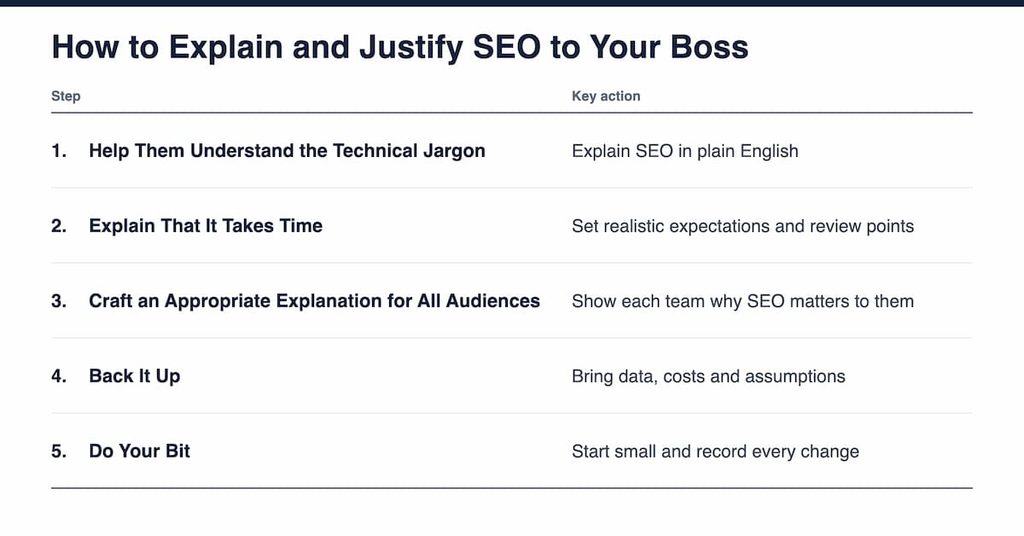
The following tips will help you to explain and justify SEO to your boss.
1 – Help Them Understand the Technical Jargon
Before getting your boss convinced about the importance of SEO, one of the things that needs to be done is to clearly define SEO. Terms like keyword research, organic traffic, backlinks and technical SEO might appear quite obscure to a person who does not specialise in digital marketing.
To start with, you can introduce the basics. Search Engine Optimisation is the process through which the content of a website becomes more understandable to search engines and people find relevant information there much more easily. Such an improvement of website may include both the changes to website content and solving technical issues.
Additionally, it is very important to explain that SEO is not. In other words, it should be clear that SEO does not include payment for better organic ranking to Google. Therefore, no agency can promise a top ranking to their client.
Finally, it would be helpful to make a comparison between SEO and technical things your boss knows. For example, keyword research allows finding out what your future customers look for. Technical SEO allows reaching such a goal as the accessibility and understanding by search engines.
2 – Explain That It Takes Time
One of the major difficulties related to justifying SEO is clarifying that results rarely come overnight. In comparison with paid advertising, where you get the traffic right after the campaign is launched, in the case of SEO, it requires continued effort until the results become apparent.
Work with website content, technical issues, and search visibility requires some time for achieving measurable results. Timeframes depend on the website’s current state, its competitiveness, the scope of work, and the ability to make recommendations fast enough.
Thus, the expectations should be reasonable right from the start. Instead of promising that the website will go to the first page of Google within a specified number of weeks, it is necessary to explain what the team will do, what changes will be tracked, and at which points the results will be evaluated.
For example, the first review could include analysis of the website, identification of technical problems, and prioritisation of commercial pages. Further reviews may consider changes in organic traffic, relevant keywords visibility, number of enquiries, etc.
SEO should be regarded as a continuous process but it doesn’t mean that it is about doing something continuously without tracking any results.
3 – Craft an Appropriate Explanation for All Audiences
Getting the approval of your boss is just the tip of the iceberg. Sometimes an SEO campaign may require input from marketing, IT, sales and other departments, as well.
Everyone’s concerns will be different, so show them why SEO is relevant to their department’s operations. Managers are likely to be interested in the financial side, while marketing is concerned with the content and needs of customers. Developers will be looking at the time it will take for development, site performance and technical matters.
If there is a problem identified during the SEO audit, for instance, the marketing team and the developers should come to an agreement on how to solve it. When you find out that there are some problems that customers have but haven’t gotten answered by keyword research, the content department can take these results into account when planning articles.
Show how an SEO campaign is something that requires teamwork, not a project for a single department.
If you are considering hiring an external SEO company, explain which tasks it would handle, what your internal team would still need to do and how both sides would work together. This helps management understand the practical implications of the investment before making a decision.
4 – Back It Up
It is easy to tell your boss that SEO could improve the business, but a convincing proposal needs evidence to support the argument.
First, you need to assess the current website performance. Google Search Console can be used to check such metrics as search impressions, clicks and searches, while website analytics can show how users behave after they visit your site. Enquiry data and sales numbers can give more information on whether the traffic brings you closer to achieving your objectives.
Then, you need to pinpoint the opportunity. Is it hard to find crucial pages in search results? Is it impossible to answer the questions customers pose through search? Are there any technical issues making search engines unable to reach some important pages? Using the available data, show why certain problems have to be addressed first.
You should also state the costs and resources needed. Agency fees or time spent on the work should be mentioned, as well as development, content creation and other tools needed for achieving your goal. Instead of making forecasts, try to explain the assumptions you use when estimating the possible return.
For instance, in case your objective is to gain more qualified enquiries, you need to define what constitutes an enquiry and how you are going to estimate its worth.
A useful SEO proposal should answer a few straightforward questions:
- What business problem are we trying to solve?
- What evidence suggests SEO could help?
- What work needs to be completed, and how much will it cost?
- How will we measure progress?
- What risks or dependencies could affect the outcome?
Clear evidence and realistic assumptions give management a stronger basis for making a decision than promises about rankings alone.
5 – Do Your Bit
It is highly unlikely that just informing the boss about the company’s need for SEO will be enough to convince him. One must take action and prove the usefulness of SEO in terms of achieving the company’s goals.
Start from small steps which you can afford to perform and that are within your capacity. For example, one can conduct research on the customer’s search queries and improve existing content or check whether all necessary pages have proper titles and descriptions.
One can also use different services to monitor the progress and find weaknesses in the site’s performance (Google Search Console, Google Analytics). Write down everything that was changed and compare it to the initial state, considering other possible influences.
But one should not change anything just to show his work. All activities must be aimed at some goal: helping customers find information, increasing accessibility of certain pages or facilitating the process of relevant enquiries from the customers.
Moreover, one should understand when he needs assistance. It can be needed for technical problems (for developers) or research/strategy issues (SEO specialist). Tell what you can do and what can be improved by others.
Taking responsibility, communicating progress and learning from the results can help you build a stronger case for further investment.
Ready to put these ideas to work?
Justifying SEO to your boss is easier when you connect the work to a real business need. Explain the basics in plain language, set realistic expectations, involve the right teams and support your recommendations with evidence.
You do not need to promise first-page rankings or immediate results to make a convincing argument. Instead, present a clear plan, explain the investment required and agree on how progress will be evaluated.
TBS’s SEO consulting service can help businesses clarify their priorities and define the scope of an SEO strategy. An SEO audit can also help identify technical and content issues that need attention.
Start by identifying one business problem that SEO could help address, gathering the evidence to support your recommendation and outlining the next steps. A well-supported proposal gives management a clearer basis for deciding whether to invest and how to evaluate the results.
Sign in to share. Facebook and LinkedIn need the article page to be publicly accessible to show its preview. If an AI cannot open the page, copy the article text from the section above.