

Choose an AI service. ChatGPT and Perplexity submit the summary request, Grok opens it ready to send, and other services open with the request copied as a fallback. If an AI cannot open the page, copy the article text and paste it into the chat.
It is possible to draw a parallel between search engine optimisation and work habits by making important stuff accessible and communicating effectively through delivering something valuable and establishing trust. While those can be used to analyse your routine at work, they are not a recipe for your success.
Search engine optimisation implies a combination of technical, content and reputation factors. Our introduction to SEO explains the practice itself. Here, the aim is to borrow a few practical habits from it without pretending that people work like search engines.
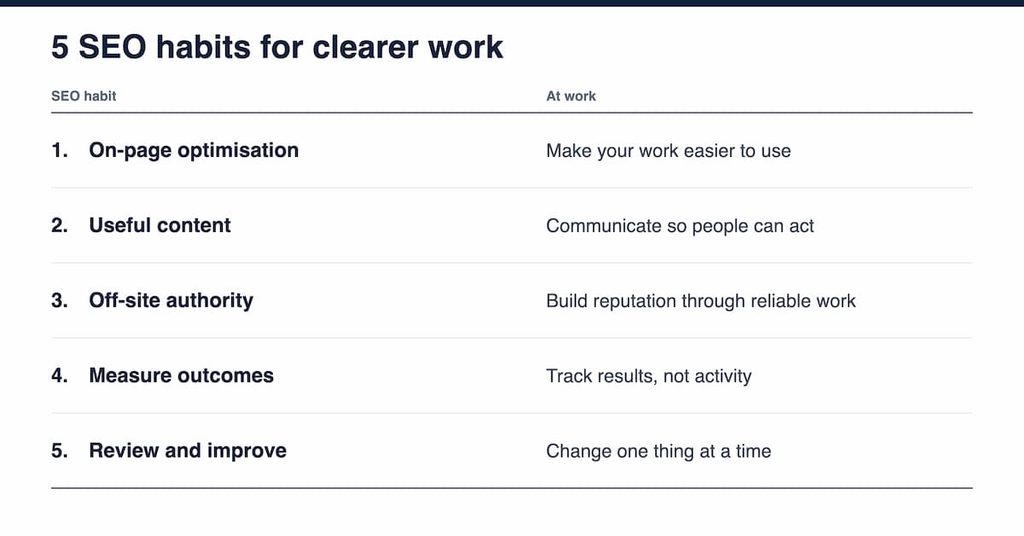
1. On-page optimisation: make your work easier to use
A helpful site allows the visitor to understand the deal and locate the next move. In work, the equivalent would be ensuring clarity of information and responsibility. The person should be able to locate the existing brief, determine the owner and determine what is required.
Perform an informal audit of information. Do you have multiple files named “final”? Is the information spread across different emails? Does the handover list out what has been completed and what is remaining? Removing such barriers might be more helpful than introducing another tool.
For example, instead of a confusing project folder, consider a single approved brief, descriptive file naming and a quick status update. It is about usability, not presentation.
2. Useful content: communicate to help someone act
In SEO, the content must be for the audience, not just to meet deadlines. The “helpful content” guidelines from Google ask if the information is valuable and helps the user accomplish their task. Consistent production is not enough to ensure good rankings.
The same rule applies to a meeting, an update or a presentation. What should the recipient be told? What decision must be made? What information will make it easier to make this decision? Start with the answer, then include additional information that some readers may require.
For example, a useful project update might look like: “Draft ready. Kindly verify the pricing part by Thursday. Specifications have been reviewed by the product team.” Here we state the facts, the actions that must be taken and what has been done.
Our guide to explaining technical subjects offers more ways to adapt detail to the audience. Clear communication respects the reader’s time while preserving the facts and limitations.
3. Off-site authority: build a reputation through reliable work
The ranking systems employed by Google involve link analysis; however, links are just one aspect. The metaphor of a professional environment implies that reputation is based on real-life experience; there will be witnesses who could tell about your contributions and their positive impact.
It is important to maintain reasonable expectations, give credit to others, and provide proof that the task has been completed successfully. Proper transfer of responsibility, an explanation, or reliable follow-up provides something tangible to rely upon.
Relations cannot be quantified or seen as opportunities to advance only. Request constructive feedback from others and try to help wherever possible. Recommendation becomes more valuable if it comes from a real contribution.
4. Measure outcomes rather than activity
A cluttered marketing report may obscure whether proper inquiries were made by the firm. A crowded schedule may similarly mask the progress of critical tasks. Pick an output that matches the job before selecting a metric.
In case of a repeated report designed to inform a decision, focus on whether it became easier or quicker, not on the number of pages generated. Where the issue lies in a handover, measure missing information and follow up questions rather than emails exchanged.
Do not turn everything you do daily into a dashboard. Use metrics to address a genuine question, while being aware of uncontrollable factors.
5. Review and improve without changing everything at once
SEO alterations may take time to be evaluated and some alterations might not yield any result at all. The most important thing to learn from this is giving an alteration a decent trial and taking note of what was altered.
As for work processes, try out one simple change, like a more detailed weekly brief or a checklist. Set up a date to evaluate this change and listen to the users of this process about what still hinders them and leave only useful elements.
Consistency becomes helpful only in case when the process fulfills its role. No point in keeping something ineffective just because it takes effort.
A simple review to try this week
Choose one recurring task and answer three questions:
What makes it harder for someone else to use my work?
What information would help them take the next step?
What evidence would show that the change helped?
Make one improvement, name the person responsible and set a review date. This is a practical exercise, not a validated productivity programme or a promise that every obstacle can be solved by working harder.
Apply the same discipline to your marketing
For a business, these habits translate into clearer priorities and better discussions about results. Our guide to explaining SEO to your boss connects the work with commercial decisions rather than relying on technical language alone.
TBS’s SEO consulting service can help turn a broad marketing task list into priorities. Content marketing services can support useful explanations and customer-focused material. Agree the business problem, scope and evidence of progress before choosing the activity.
Start with something people genuinely need from you or your business. Make it easier to find, understand and use, then review whether the change worked.
Sign in to share. Facebook and LinkedIn need the article page to be publicly accessible to show its preview. If an AI cannot open the page, copy the article text from the section above.