
Choose an AI service. ChatGPT and Perplexity submit the summary request, Grok opens it ready to send, and other services open with the request copied as a fallback. If an AI cannot open the page, copy the article text and paste it into the chat.
Performance marketing is a measurable approach to online advertising in which a business plans campaigns around defined actions or outcomes, then tracks results to decide what to improve. Those outcomes might include clicks, leads, purchases, app installs, or qualified appointments. The approach connects marketing spend to observed activity, but it does not mean every ad is paid for only when a customer converts.
To use performance marketing well, choose an outcome that matters to the business, select channels that can reach the right audience, set up reliable measurement, and optimize from what the data shows. Affiliate marketing, paid search, social advertising, and native advertising can all support that process. Search engine optimization can contribute to measurable growth too, although it usually does not use the same paid placement or commission model as an ad campaign.
What Is Performance Marketing?
Performance marketing, also called performance-based marketing, is online marketing planned and evaluated against specific, trackable results. A campaign may aim to generate a purchase, form submission, phone call, subscription, app install, or another action the advertiser values. Marketers use campaign data to assess whether the activity is meeting its goal and to adjust the audience, creative, channel, landing page, or budget.
Performance marketing can also build awareness and loyalty. A campaign might introduce a brand to new customers, encourage a repeat purchase, or bring past visitors back to a website. The key difference is not that every exposure produces an immediate sale. It is that the marketer defines what success looks like and uses evidence to evaluate the campaign.
The market’s size reflects how central measurable digital advertising has become. The IAB and PwC report that U.S. internet advertising revenue reached $294.6 billion in the year covered by their 2026 report, increasing 13.9% year over year. The report says growth reflected a market increasingly oriented toward channels that can connect advertising investment with measurable outcomes.
Performance ads meaning: impression, click, and conversion
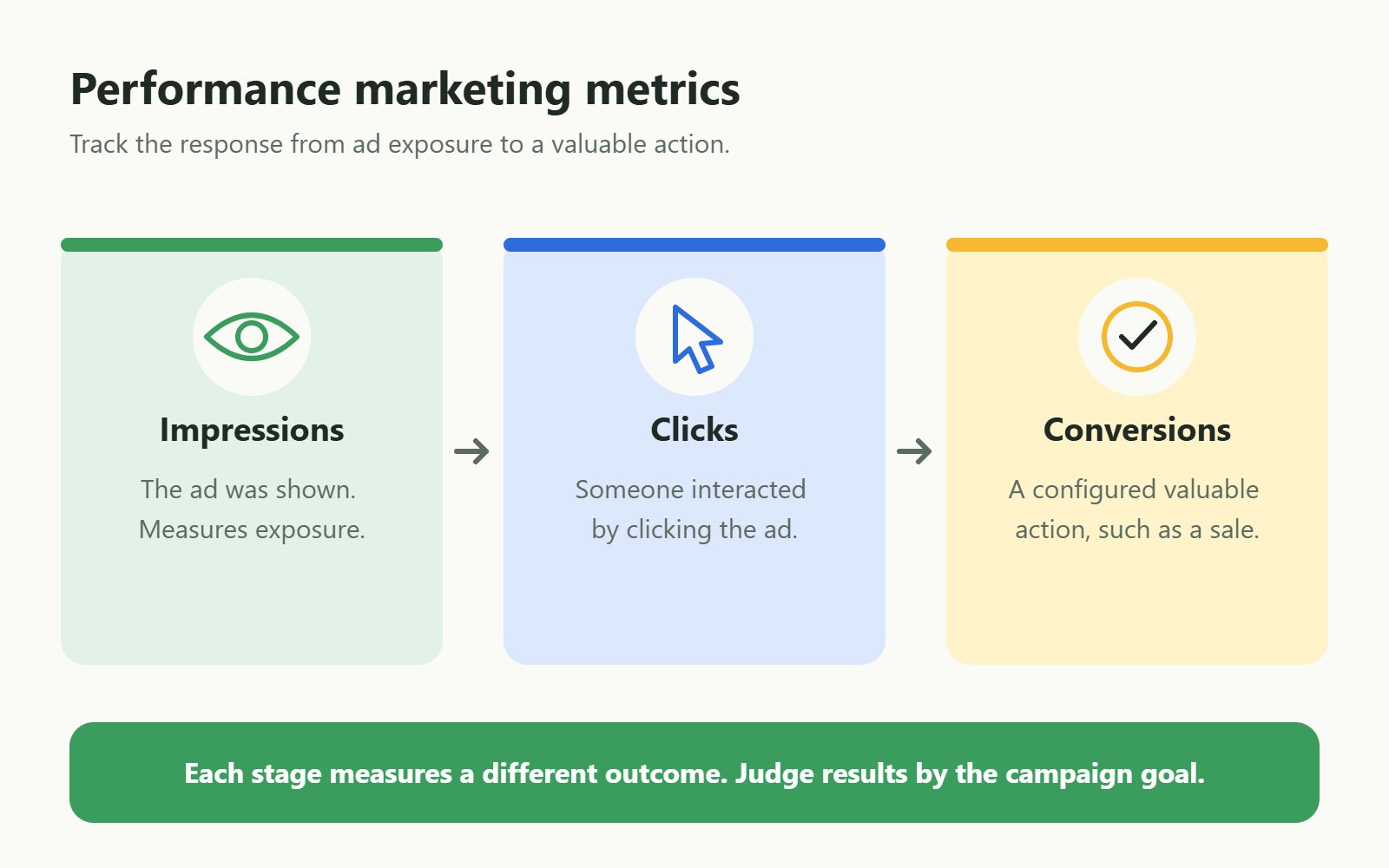
A performance ad is an advertisement designed to support a measurable marketing objective. An impression means the ad was shown. A click means someone interacted with it by clicking. A conversion is an action the advertiser has configured as valuable, such as a completed purchase or submitted lead form.
These are different stages, not interchangeable results. An ad can earn many impressions but few clicks; a high click count can still produce few conversions. A campaign should therefore be judged against its intended result, not just the easiest number to increase.
How Performance Marketing Works
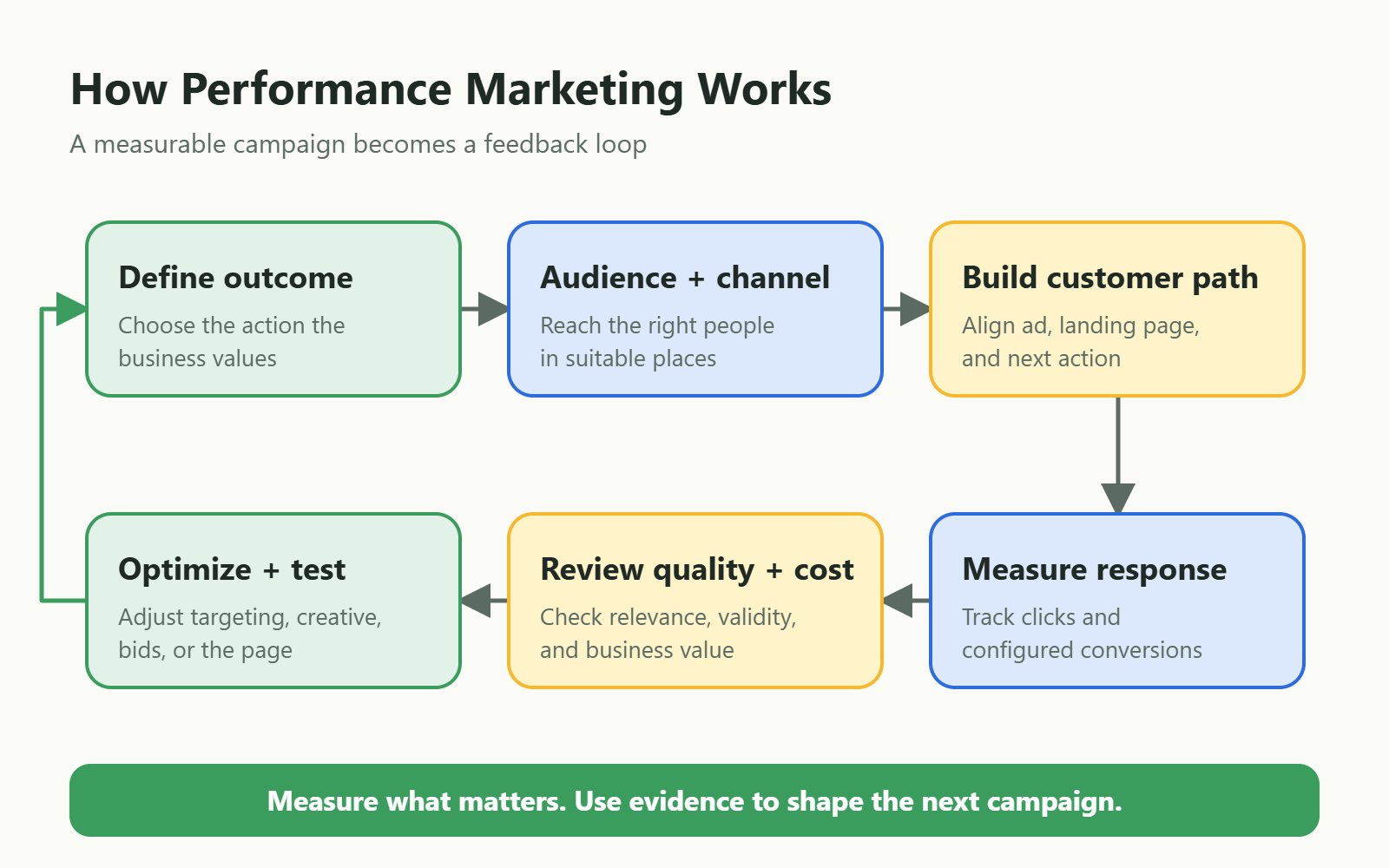
Performance marketing works as a feedback loop. The advertiser sets a goal, chooses an audience and channel, launches ads or partner activity, measures the response, and makes changes based on the results. Each step shapes the next: unclear goals produce weak measurement, while reliable conversion data helps marketers spend with greater discipline.
- Set a business outcome. Decide whether the campaign should drive sales, leads, registrations, calls, app installs, or another action.
- Define the audience and offer. Specify who the campaign should reach, what problem it addresses, and what action the audience should take.
- Choose channels and payment terms. Select paid search, social media, native ads, affiliates, or a suitable combination. Decide whether payment is based on impressions, clicks, leads, sales, or a negotiated fee.
- Build the customer path. Match the ad message to the landing page, checkout, lead form, or app experience so the next step is clear.
- Configure measurement before launch. Record the campaign’s clicks and agreed conversion events, assign values where useful, and document how credit will be attributed.
- Review quality and cost. Compare spend with the number and value of outcomes. Check whether the results are relevant, valid, and commercially useful.
- Optimize and test. Adjust targeting, creative, bids, placements, offers, or the landing page. Keep changes tied to a measurable reason.
Tracking should reflect what happens after an ad interaction. For example, if a retailer wants online purchases, a click alone is not a sale. If a service business wants qualified consultations, a form submission may be an initial conversion, but the sales team should also track whether that lead becomes a customer.
What performance marketing requires
Effective performance-based advertising requires more than an ad budget. It needs a defined outcome, a channel suited to that outcome, a workable offer, accurate tracking, a clear attribution rule, and a process for acting on results. Without those pieces, campaign reports may show activity without revealing whether the activity supports business goals.
- A specific goal: “Increase sales” is a direction; a useful campaign brief also identifies the product, audience, target action, and evaluation period.
- A credible measurement setup: Define conversion events and check that the reporting system records them consistently.
- Relevant creative and landing pages: The ad promise should match the experience people find after clicking.
- Budget and guardrails: Set spending limits, acceptable cost ranges, and rules for pausing placements that do not meet quality standards.
- Enough context to interpret results: A change in sales may reflect factors beyond advertising, including pricing, stock, seasonality, or the sales process.
Performance Marketing Channels and Payment Models
Channels differ in how they reach people, what they can measure, and how advertisers pay. A company does not need to use every channel. Choose based on the audience, the offer, the customer journey, and the quality of available measurement.
| Channel or model | How it works | Common way to evaluate it | Watch for |
|---|---|---|---|
| Paid search / PPC | Advertisers bid on search terms or audiences to show sponsored results. PPC means pay per click. | Clicks, conversion rate, cost per lead or sale, and return on ad spend | Irrelevant search terms, costly clicks, and weak landing-page fit |
| Social media advertising | Paid ads reach selected audiences in social feeds, stories, video, or other placements. | Reach, clicks, conversions, cost per action, and revenue attributed to the campaign | Engagement that does not lead to the business outcome, plus placement quality |
| Native advertising | Sponsored content is designed to fit the format and context of the page where it appears. | Impressions, clicks, engaged visits, leads, or sales, depending on the objective | Clear ad identification, audience relevance, and the quality of traffic |
| Affiliate marketing | Partners promote a business’s products or services under agreed tracking and payment terms. | Tracked leads, orders, commission, cancellations, and customer quality | Attribution rules, invalid referrals, disclosure, and commission terms |
| SEO | Search engine optimization improves the site’s visibility and usefulness in unpaid search results. | Organic visits, rankings, qualified leads, and sales over time | SEO is not usually a paid-per-click channel; outcomes can take time and depend on many factors |
Paid search marketing and PPC
Paid search places sponsored ads in search results when people search for relevant products, services, or information. Advertisers may bid on keywords and use either manual or automated bidding approaches. PPC stands for pay per click: the advertiser pays when a qualifying click occurs under the platform’s rules.
Paid search can work well when people already express intent through their searches. A company might bid on terms related to its product, service category, or location. Keyword selection, ad relevance, bidding, and the landing-page experience all affect the campaign’s results. Google Ads defines impressions as occasions when an ad appears, clicks as interactions with the ad, and conversions as configured actions such as purchases or sign-ups.
Social media marketing and paid social
Social media marketing includes organic activity and paid campaigns on social platforms. Performance-focused paid social uses audience and placement options to encourage a defined response, such as a purchase, lead, app install, or website visit. A campaign can also support awareness, but marketers should identify how they will evaluate that objective before launch.
Do not treat likes or views as proof of business impact by themselves. Compare them with the campaign’s purpose. If the goal is customer acquisition, assess qualified conversions and acquisition cost alongside reach and engagement.
Native advertising
Native advertising is paid content that adopts the look or format of the surrounding environment while remaining advertising. A sponsored article, in-feed placement, or promoted recommendation may be native if it fits the context in which it appears. Native does not mean undisclosed: people should be able to recognize advertising as advertising.
Depending on the agreement, an advertiser may pay for impressions, clicks, or other results. The payment model should not be confused with the ad format. A native ad can be bought on an impression basis, while a campaign using another format may be billed on clicks or conversions.
Affiliate marketing and affiliate roles
Affiliate marketing is a popular form of performance marketing in which a business works with partners to refer traffic, leads, or customers. A retailer or service provider is typically the advertiser or merchant. An affiliate partner promotes the offer through an approved channel and receives compensation under the program’s terms.
Partners can include publishers, product reviewers, comparison sites, loyalty or rewards programs, creators, and other businesses with an audience relevant to the offer. Their contribution may be an introduction, recommendation, referral, or sale. The advertiser should select partners for audience fit and trustworthy promotion, not just reach.
Affiliate managers recruit and support partners, communicate program rules, review performance, and coordinate commission payments. A business may manage the program internally or hire an outsourced program manager. Before selecting an outside provider, check its relevant experience, references, service scope, reporting practices, contract terms, and the parties’ ownership of content, accounts, and data.
Affiliate networks provide a platform where advertisers and partners can find or manage program activity. Depending on the service, a network may support tracking, links, reporting, offers, and payment administration. Compare the tools and fees with the program’s needs, and confirm which party handles validation, disputes, and payouts.
How affiliate payment works
Affiliate payment depends on the written program agreement. A program may pay a commission for a completed sale, a fee for an approved lead, a flat placement fee, or another agreed arrangement. Pay per sale pays the partner when an eligible purchase is attributed to its referral. Pay per lead compensates a partner for an agreed lead event, subject to any quality or validation rules.
An impression or click is not automatically an affiliate conversion. If a partner is paid for a placement or click, the contract should say so. If the agreed action is a sale, define how tracking, returns, cancellations, duplicate orders, and attribution disputes will be handled.
When affiliates or creators endorse a product, advertisers should make sure material relationships are disclosed clearly near the recommendation. The Federal Trade Commission advises that disclosures should be clear and conspicuous so audiences can understand the relationship behind an endorsement.
SEO and the post-click experience
Search engine optimization helps people find useful pages through unpaid search results. SEO can support performance goals by attracting relevant visitors, but it is not typically an ad-buying model in which an advertiser pays for each click. Treat organic and paid search as distinct channels in reporting, even when both contribute to the same business outcome.
After a visitor arrives, the landing page influences whether the campaign can convert. Make the offer, proof points, and next step easy to understand. Use A/B testing to compare one meaningful change at a time, such as a headline, form length, or call-to-action. Track completed conversions, not just page views, and avoid drawing conclusions from a test before the data is useful enough for the decision.
How to Plan a Performance Marketing Campaign
A campaign brief translates a business objective into choices about audience, channel, creative, budget, and measurement. Build that plan before buying media or recruiting partners. It helps teams align on what they want, how they will count success, and what they will change if results fall short.
1. Choose the outcome and target audience
Start by naming the action the campaign should produce. For an ecommerce business, that might be a completed order. For a local service provider, it could be a qualified call or booked appointment. For a software company, it might be a trial registration that later becomes a paid account.
Describe the audience in terms that guide channel and creative decisions: needs, location, product fit, stage in the decision process, and any relevant exclusions. A broad audience may produce more activity but not necessarily more valuable outcomes.
2. Set a target and establish economics
Decide what a viable result looks like before the campaign starts. Estimate the maximum acceptable cost per lead or sale using expected revenue, margin, conversion from lead to customer, and other relevant business costs. A target based only on competitors’ reported numbers may not reflect your own economics.
For a lead campaign, calculate how many leads typically become customers and what a customer is worth to the business. For an ecommerce campaign, distinguish revenue from profit. A positive return on ad spend does not automatically mean a campaign is profitable after product, fulfillment, agency, and other costs.
3. Pick channels and placements that fit the goal
Choose a channel based on customer behavior and the campaign objective. Search can reach people expressing intent; social ads can introduce an offer to selected audiences; affiliates can bring partner referrals; native placements can reach readers in a relevant content environment. Test a manageable number of channels so you can interpret results and maintain budget control.
Placement matters as much as channel. Decide where ads should appear, what content or audience is suitable, and which placements should be excluded. For affiliate programs, set clear rules on approved promotion methods and prohibited claims.
4. Create the offer, ad, and landing page
Make sure the ad and destination tell the same story. If an ad promises a specific product, discount, or service, the landing page should present that offer clearly and make the next step easy. Remove unnecessary friction from forms and checkout while keeping any information needed to qualify or serve customers.
Test creative and page elements with a specific hypothesis. For example, a retailer might compare two product messages to learn which one brings more completed orders, not just more clicks. A service business might test whether a shorter form improves qualified submissions without reducing lead quality.
5. Set up tracking and attribution
Before launch, define which events count as conversions and verify that they are recorded. If a campaign generates leads, include a method to distinguish valid prospects from spam or duplicates. If a campaign generates sales, account for cancellations and refunds where possible.
Attribution is the method used to assign credit for an outcome to marketing interactions. Different systems may give different channels credit for the same customer journey. Agree on the reporting method, lookback period, and treatment of cross-device or offline activity before using results to compare partners or channels.
6. Launch, inspect, and optimize
Check early delivery for broken tracking, incorrect targeting, misleading placements, and unusual traffic patterns. Then review results on a schedule that fits the channel and campaign volume. Avoid making frequent changes based on small or noisy samples.
When performance falls short, diagnose the step where the journey breaks. Low impressions may point to reach or bidding constraints. Impressions without clicks may signal weak creative or audience fit. Clicks without conversions can indicate poor landing-page relevance, an unattractive offer, or a tracking problem. Conversions at an unsustainable cost may require changes to targeting, pricing, or the economics of the offer.
Performance Marketing Metrics: What to Track and When
Campaign KPIs and metrics help marketers monitor performance, but the right metric depends on the goal. Use a small set that links delivery to business outcomes. Google Ads describes metrics such as clicks, impressions, click-through rate, conversion rate, cost per conversion, and return on ad spend as ways to monitor campaign activity and value.
| Metric | What it measures | Formula or interpretation | Useful for |
|---|---|---|---|
| Impressions | How many times an ad was shown | A delivery count, not a count of unique people or conversions | Awareness and delivery checks |
| CPM | Cost per thousand impressions | Ad spend ÷ impressions × 1,000 | Comparing impression-based media costs |
| Clicks | Recorded interactions with an ad | Count clicks according to the platform’s reporting rules | Traffic and ad engagement checks |
| CPC | Average cost for a click | Ad spend ÷ clicks | Evaluating traffic cost |
| CTR | Share of impressions that result in a click | Clicks ÷ impressions × 100 | Assessing relevance and response to an ad |
| Conversion rate | Share of a defined audience or traffic group completing an action | Conversions ÷ the chosen denominator × 100 | Evaluating the path from visit or click to outcome |
| CPA / cost per conversion | Average cost for a specified action | Ad spend ÷ conversions | Comparing cost of leads, sales, or other actions |
| CPL | Average cost per lead | Campaign cost ÷ leads | Lead generation, with lead quality checked separately |
| ROAS | Revenue attributed to ads compared with ad spend | Attributed revenue ÷ ad spend | Revenue efficiency, not full business profitability |
| CAC | Cost to acquire a customer | Acquisition costs ÷ new customers, using a clearly defined scope | Comparing acquisition cost with customer economics |
| LTV | Estimated value of a customer over the relationship | Use a documented business model and time horizon | Assessing longer-term customer value alongside acquisition cost |
CPC and CPM
Cost per click (CPC) is average advertising spend divided by the number of clicks. It helps show what the campaign pays to bring someone to the next step, but it does not tell you whether that visitor becomes a lead or customer.
Cost per thousand impressions (CPM) is the cost of serving one thousand ad impressions. The word “mille” in CPM refers to one thousand. A campaign bought on CPM can deliver exposure without generating a click, so compare the metric with outcomes appropriate to the campaign’s objective.
CPA, CPL, and pay per sale
Cost per action (CPA) or cost per conversion is the average campaign cost for a defined action. The action might be a registration, download, lead, or purchase. Define the event precisely so reports do not combine high-value and low-value actions as if they were equivalent.
Cost per lead (CPL) is the campaign cost divided by the number of leads. A low CPL can still be poor performance if the leads are inaccurate, unqualified, or unlikely to become customers. Connect lead reporting to downstream sales where possible.
Pay per sale (PPS) describes a payment arrangement in which compensation is due for an eligible sale after an attributed referral. It is a payment term, not a universal guarantee of profitability. Returns, cancellations, discounts, and the commission rate all affect the final economics.
CTR, conversion rate, ROAS, CAC, and LTV
Click-through rate (CTR) is clicks divided by impressions. It helps assess whether people who saw an ad responded to it, but a high CTR does not prove that the clicks were valuable. Pair CTR with conversion and quality measures.
Conversion rate is the share of a defined group that completes a chosen action. State the denominator, such as clicks, sessions, or leads, because different denominators produce different rates. A platform’s definition may also differ from a company’s analytics or sales reporting.
Return on ad spend (ROAS) compares attributed revenue with advertising spend. If a campaign reports $3 in attributed revenue for each $1 of ad spend, its ROAS is 3:1. That ratio does not subtract product cost, agency fees, shipping, overhead, or other expenses.
Customer acquisition cost (CAC) estimates the cost to gain a new customer. Specify which costs and customer sources are included. Lifetime value (LTV) estimates the value of a customer relationship over a defined period or using a stated model. Compare LTV and CAC carefully: a forecast is not guaranteed revenue, and the measures need consistent definitions.
Worked example: using spend, conversions, and revenue
Suppose an online store spends $1,200 on a campaign and records 600 clicks, 40 purchases, and $3,600 in attributed revenue. The average CPC is $2, the cost per purchase is $30, and ROAS is 3:1, or 300% when expressed as a percentage.
Those figures show that the campaign generated attributed purchases at a measurable cost. They do not prove the campaign made a profit. The retailer should compare the $3,600 in revenue with product margin, fulfillment, discounts, returns, and other costs. It should also confirm that the 40 purchases were valid and that the attribution method gives a fair account of the customer journey.
If the clicks are inexpensive but purchases are scarce, review search terms or audience fit, the ad promise, and the checkout experience. If the conversion rate is healthy but the cost per purchase is too high, test bids, targeting, offer economics, or channel mix. Change one or a small number of factors at a time so results remain interpretable.
Benefits and Risks of Performance-Based Marketing
Performance marketing can make campaign decisions more accountable because marketers can connect spend with defined actions and update activity as results come in. Paying an affiliate after an agreed result, for example, may limit payment for unconverted referrals. That arrangement can support return on investment, but it does not guarantee a higher ROI or lower acquisition cost.
Potential benefits
- Clearer accountability: Teams can agree on the campaign goal and review whether activity is delivering it.
- Ongoing optimization: Marketers can adjust creative, audiences, bids, placements, and landing pages using observed performance.
- Flexible payment structures: Depending on the channel and agreement, advertisers may pay for exposure, clicks, leads, sales, or services.
- Channel comparison: Consistent definitions help teams compare costs and outcomes across campaigns, while recognizing that attribution is not always directly comparable.
- Partner reach: Affiliates can introduce offers to relevant audiences that a company may not reach efficiently on its own.
Risks and limitations
- Attribution gaps: A conversion may involve several channels, devices, or offline interactions. Different reporting systems can assign credit differently.
- Click fraud and bot traffic: Automated or invalid activity can inflate clicks or impressions. Monitor traffic quality and follow platform and partner dispute processes.
- Publisher or placement fraud: A report may not tell the whole story about where an ad appeared or how a referral was generated. Set placement controls and audit partner activity.
- Privacy and tracking limitations: Consent choices, browser settings, device changes, and applicable privacy requirements can affect what marketers can observe. Collect and use data responsibly, and seek qualified advice for legal obligations.
- Misaligned incentives: A partner paid only for volume may prioritize quantity over quality. Define acceptable traffic, lead validation, and prohibited tactics.
- Brand suitability: Ads or affiliate promotions can appear in environments or alongside claims that do not fit the brand. Set standards and review placements.
- Short-term optimization: Optimizing only for an easy-to-record action can neglect customer quality, repeat purchases, margin, or long-term brand effects.
Reduce risk with clear contracts, conversion definitions, budget limits, reliable tracking, and regular quality checks. Treat performance data as evidence for decisions, not as a complete explanation of why customers buy.
Performance Marketing for Retail and Ecommerce
Retail performance marketing connects product discovery and promotion with online purchases or measurable store actions. A retailer may combine paid search, shopping ads, social campaigns, affiliate partners, product-feed optimization, and conversion measurement. The right mix depends on the product catalog, margins, inventory, customer demand, and the retailer’s ability to measure results.
- Paid search and shopping ads: Promote products or categories to people searching with relevant intent.
- Affiliate partnerships: Work with creators, publishers, comparison sites, or loyalty partners under transparent commission and tracking terms.
- Product-feed optimization: Keep product titles, descriptions, availability, prices, and images accurate so advertising systems and shoppers receive useful information.
- Online conversion measurement: Track purchases and, where available, product-level revenue, refunds, and order quality.
- Store measurement: Where the retailer has suitable data and permissions, connect campaigns with actions such as calls, directions, appointments, or in-store purchases.
Retailers should compare advertising revenue with product margin and stock availability, not just traffic. Promoting an out-of-stock item or a low-margin product can create clicks without useful business results. Use feed, inventory, and conversion data together when deciding where to increase or reduce spend.
Should You Hire a Performance Marketing Agency?
A performance marketing agency can provide specialist channel knowledge, campaign operations, creative testing, analytics, or affiliate program management. A retail performance marketing agency may focus on ecommerce search and shopping ads, product feeds, affiliate partnerships, and online or store conversion measurement. An agency can add capacity, but it cannot fix unclear goals or poor data without the client’s cooperation.
Benefits and drawbacks of working with an agency
| Potential benefit | Potential drawback | Question to ask |
|---|---|---|
| Specialist experience across selected channels | Expertise may not match your industry, audience, or campaign needs | Which channels and business models have you managed that resemble ours? |
| Additional capacity for execution and reporting | Agency fees add cost, and your team still needs to provide direction and approvals | Who will do the work, how much time will they commit, and what does the fee include? |
| Structured testing and campaign management | You may have less day-to-day control over campaign changes | What changes can the agency make without approval, and how are they documented? |
| Access to tools or established processes | Reporting may depend on agency systems or definitions you cannot independently verify | Will we have direct access to accounts, raw performance data, and tracking settings? |
| Support recruiting and managing partners | Attribution disputes, partner quality, and transparency still require oversight | How do you validate referrals, handle disputes, and disclose partner relationships? |
Common agency pricing arrangements
Agency pricing varies by scope, channel, workload, and contract. Common arrangements include a fixed monthly retainer, a project fee, an hourly fee, a percentage of media spend, or a performance-linked component. Some engagements combine more than one model. Ask what the fee covers, whether ad spend is separate, how additional work is priced, and whether performance fees depend on a clearly defined attribution method.
Performance-linked compensation can align incentives, but it can also create disagreements if the agency and client define a qualified lead, sale, or attributed result differently. Put the formula, reporting source, validation rules, payment timing, and treatment of cancellations or refunds in writing.
Agency selection checklist
- Channel fit: Can the agency explain why its recommended channels match your audience and goal?
- Relevant evidence: Ask for case studies with clear objectives, methods, and outcomes. Clarify which results came from the agency’s work and how they were measured.
- Measurement plan: Confirm conversion definitions, attribution rules, reporting cadence, and the treatment of invalid activity.
- Transparency: Find out whether the agency discloses media costs, partner fees, commissions, and any other compensation.
- Account and data ownership: Keep appropriate access to ad accounts, analytics, creative, tracking, and customer data. Specify what happens when the contract ends.
- Contract terms: Review scope, approval rights, cancellation terms, confidentiality, data handling, and ownership of work.
- Communication: Identify the day-to-day contact, escalation path, reporting format, and decision-making responsibilities.
- Brand and compliance controls: Ask how the agency checks ad claims, affiliate disclosures, placements, and partner conduct.
Frequently Asked Questions About Performance Marketing
How does performance marketing work?
A business defines a measurable goal, chooses an audience and channel, runs a campaign, and tracks agreed actions such as clicks, leads, or sales. It then reviews cost and outcome quality, adjusts campaign elements, and continues measuring against the original goal.
What is performance-based advertising?
Performance-based advertising is advertising evaluated against a specified result, such as a click, lead, purchase, or install. The advertiser may pay by impression, click, conversion, or another negotiated arrangement; the term does not mean every ad payment depends on a completed sale.
What metrics are used to measure marketing performance?
Common metrics include impressions, CPM, clicks, CPC, CTR, conversion rate, CPA, CPL, ROAS, CAC, and LTV. Choose metrics that match the campaign objective, and define each one clearly. For example, a lead campaign should track both cost per lead and lead quality where possible.
Is affiliate marketing the same as performance marketing?
No. Affiliate marketing is one type of performance marketing. Performance marketing also includes paid search, paid social, native advertising, and other campaigns measured against defined outcomes. Affiliate partners can be paid for sales, leads, or other actions specified in their agreement.
What are the pros and cons of working with a performance marketing agency?
An agency may add channel expertise, execution capacity, and structured testing. The trade-offs can include fees, less direct control, and questions about attribution or reporting transparency. Before hiring one, check channel fit, case studies, measurement practices, account access, contract terms, and ownership of data.
Can SEO be part of performance marketing?
SEO can support measurable outcomes such as qualified organic visits, leads, and sales. However, SEO is generally not paid advertising, and results do not follow the same per-click or affiliate commission model. Report organic search separately from paid campaigns while assessing how each contributes to the business.
Sign in to share. Facebook and LinkedIn need the article page to be publicly accessible to show its preview. If an AI cannot open the page, copy the article text from the section above.