
Choose an AI service. ChatGPT and Perplexity submit the summary request, Grok opens it ready to send, and other services open with the request copied as a fallback. If an AI cannot open the page, copy the article text and paste it into the chat.
A diverse marketing approach involves incorporating different media in ways that meet varied customer needs without being too dependent on one stream of leads or sales. This is about improving the bottom line through an effective and manageable combination of approaches.
The number of channels does not guarantee increased profits. Begin with what works for you, look at the gaps in your customer cycle, and test a new channel with the goal of increasing profits in mind.
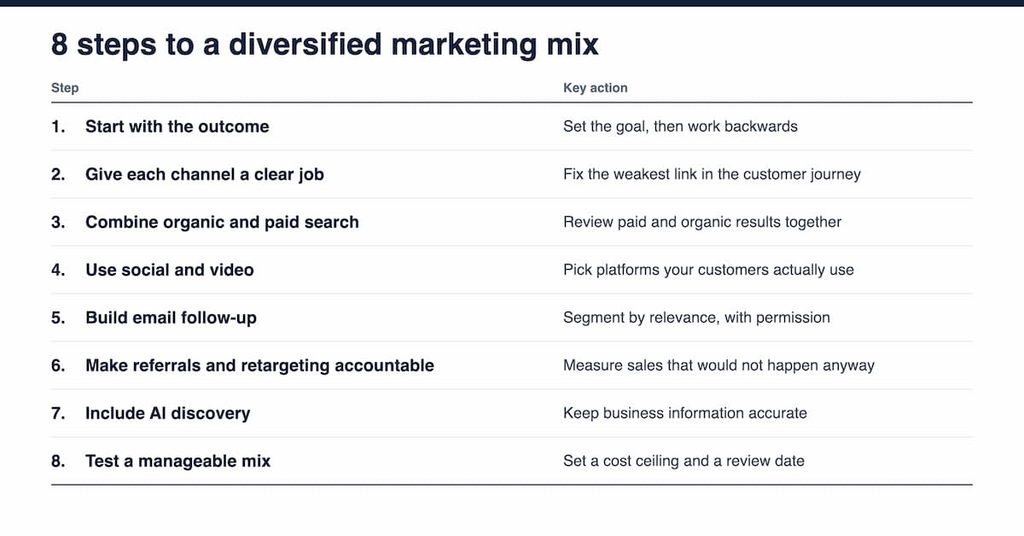
Start with the outcome and the economics
Decide on the need for the business: appropriate inquiries, initial purchase, repeated purchase, or a move into a new market. Work backwards from there to determine the right offer and information.
Separate ROI from ROAS. ROAS is the ratio of attributed revenue against the cost of the advertising. A simple calculation of marketing ROI is: (Incremental contribution from before marketing costs less marketing costs)/marketing costs * 100. Ensure the costs, time period and attribution are well-defined for the sake of interpretation.
For instance, when incremental sales are ฿30,000 after deducting product and variable fulfillment costs, and marketing efforts to achieve this cost ฿20,000, the ROI is 50%. This is an example and not a prediction. When it is impossible to predict incremental sales, the output should be attributed.
Give each channel a clear job
A good combination can assist users in discovering an issue, comparing choices, purchasing something and returning in the future. Find out the weakest link in the chain rather than copying your competitor’s platform combinations.
In case of the local services firm, this may include searching pages explaining the service, advertising campaign dedicated to a particular offer and follow-up emails encouraging future purchases. For the retailer, it may include demo videos, product discovery and relevant emails.
These are working hypotheses you need to verify. Make sure that the brand promises and essential facts remain consistent in all channels. Use the right format for the audience, but don’t promote different availability, prices or service conditions simply because different teams manage these platforms.
Combine organic search with focused paid campaigns
Organic search can support recurring questions and service discovery. Paid search can help test a time-sensitive offer or reach relevant demand while other work develops. Neither guarantees a return, and advertising does not buy better organic rankings.
Choose search terms that match what you can deliver, send visitors to a relevant page and check the quality of the resulting enquiries. Our guide to SEM explains how search activity fits together, while our Google Ads campaign tips cover practical planning decisions.
Review paid and organic results together. A paid campaign may bring new customers, but it may also capture some people who would otherwise have found you through an existing result. Use experiments where feasible rather than assuming all attributed conversions are additional.
Use social and video where they help people decide
The social media platform will get your message out, showcase your product, and build up familiarity even before your prospect has searched for you. Select platforms based on your customers’ feedback and the content you can create, instead of just putting yourself out on all platforms simply because you think you must.
Frame your strategy around practical considerations – what your services entail, how your product works, what audience is best for it, and where its boundaries lie. Rather than composing disconnected messages for individual platforms, adapt a good explanation to different formats.
Measure your performance according to your planned objective. Building awareness and consideration may not necessarily result in clicks, but merely viewing and liking is not enough to give you any commercial advantage.
Build relevant email and customer follow-up
Email can enable repeat buying, useful education, and reactivation when permission is given to communicate appropriately. The fact that an email address has been collected does not mean that all types of promotion are justified.
Segment based on relevance, such as interest in a product, buying behavior, or point in the sales cycle, but take into account any relevant privacy rules. Mix newsletters with messages that address a need, such as an educational guide.
Measure purchases, responses, unsubscribes, and email delivery issues. Do not assess email on the basis of an old industry average ROI figure or increase the number of emails sent because it is cheap.
Make referrals and retargeting accountable
Referral programmes incur costs, although their primary cost is the reward that is given following the purchase. Establish eligibility, reward caps and a procedure for dealing with any duplicates or self-referrals. Look at the profit margin on the resultant business before extending the offer.
Retargeting may alert a potential customer about an offer but the visit is no indication of being ready to make a purchase. Make use of allowable audiences and reasonable frequency controls while excluding unqualified customers where necessary.
Measure the effectiveness of your retargeting campaigns against the sales that would have occurred in the absence of the campaigns. Attribution credit and incremental value are separate issues. Google’s Conversion Lift provides controlled comparison analysis of incremental conversion.
Include AI discovery without chasing every new tool
AI answers and assistants help you create more opportunities for your business to appear before your customers even reach your website. According to Google, all of the classic SEO methods still apply to AI Overviews and AI Mode; there is no need for any special AI schema or text file. The inclusion cannot be guaranteed.
It’s crucial to make sure the information about the business, its products and their explanation by the customers stays precise and accurate in the appropriate sources. It is necessary to track a predetermined set of relevant questions in case AI visibility was part of the strategy and to keep the record of the AI systems used.
Test a manageable mix and compare the evidence
Our digital marketing trends guide compares established and newer channels in more detail. Use it to shortlist a realistic mix, then give each experiment a cost ceiling, defined audience, qualified outcome and review date.
Include creative production, management and software in the budget. Allow for the sales cycle and seasonal changes. If you change several channels and the offer at once, it becomes harder to understand which change helped.
Reconcile campaign reports with actual customer and sales records. Platforms may claim credit for the same sale under different attribution rules, so adding their conversion totals can overstate results. Keep business totals and platform-attributed totals clearly labelled.
TBS’s Google Ads services can support a focused acquisition test. Email marketing support can help structure relevant customer follow-up, while AI marketing services can assess which discovery and automation opportunities fit your audience. Choose the support that closes an identified gap.
Protect the channels that already create value, test additions at a sustainable scale and move resources according to evidence. A smaller, coordinated marketing mix is easier to improve than a long list of disconnected activities.
Conclusion
Review each channel regularly to understand how it contributes to your overall goals, and adjust your budget where the evidence supports a change. The aim is to build a balanced marketing mix that reaches customers at different stages of their journey while keeping costs manageable and returns measurable.
Sign in to share. Facebook and LinkedIn need the article page to be publicly accessible to show its preview. If an AI cannot open the page, copy the article text from the section above.