Choose an AI service. ChatGPT and Perplexity submit the summary request, Grok opens it ready to send, and other services open with the request copied as a fallback. If an AI cannot open the page, copy the article text and paste it into the chat.
We all know how important utilising SEO can be for your company, making it easier for customers to find you and gaining more business in a long term and cheaper way than many of the other strategies out there. Semantic SEO is a relatively new development in this field which has improved and increased the way search engines understand key terms and connect you with customers. Here we will take a look at Semantic SEO, explaining exactly what it is and how it can be used to benefit you.
This shift towards understanding natural language and the nuances of context within search queries represents a significant evolution in search engine technology, as demonstrated in “The Evolution of SEO: Understanding Semantic Search,” which delves deeper into the topic.
What is Semantic SEO?
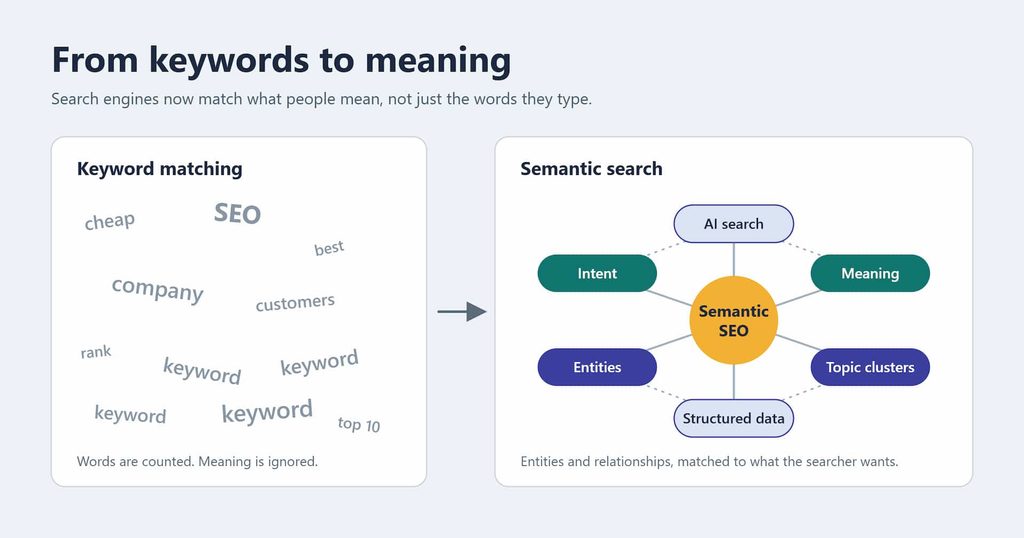
Semantics refers to the meaning behind the words, and that is exactly what Semantic SEO is all about. This allows the search engine to consider the meaning behind the words used rather than simply the words themselves, lumping together enquiries that have a similar intent even if the exact phrasing differs.
In the past, search engines could only assess what was written, and variations were not taken into account. This meant that businesses had to be precise with the language used in order to be recognised in the results. Now the algorithms today allow for the meaning and context to also be taken into account, allowing more variety in the words used as long as they conform to the same intent. The semantics behind the language can be understood and used to rank the search results based on this as well as simply the words used giving more accurate and suitable results.
The two key components of this are the meaning and intent, both of which are now considered as a part of the whole. Here we have a brief description of each as they affect Semantic SEO:
- Intent – by looking at what exactly a customer wants to get out of the search, the engine can better fill this need. The intent is exactly that – why they are performing the search and to what end. This now contributes to the ranked results.
- Meaning – as stated semantics is all about meaning, the actual meaning in the words and phrases used to convey the intent. Some words can have several meanings, or a phrase might suggest a topic without using the exact words. Semantic SEO attempts to use the correct meaning to give more relevant results and a better experience for the user.
Combining intent and meaning, Semantic SEO is the way forward to give the best results for consumers and businesses alike. When the goal and end game of the search is taken into account with the proper understanding of what they want, the ranked results will better meet that goal.

What are the advantages of Semantic SEO?
Now that we have a greater understanding of what Semantic SEO actually is, we can now look at the advantages and how it can be helpful and important to utilise for your business. You should always be working towards optimal search results through your SEO, and Semantic SEO is another excellent way to get your listings where they need to be. Here we will look at some of the advantages associated with this enhanced understanding of meaning and intent:
- The system is harder to trick – in the past when search engines simply looked for keywords it was fairly simple for any website or company to load up on what was quite often rubbish content that repeated said keywords over and over. This would raise their ranking without any regard for the relevance to the query, and without taking quality into account. Now with Semantic SEO it is not merely about having the right words but also the right meaning to suit the search, so you are more likely to appear to the right people.
- It makes the search engine easier to use and more relevant – considering the intent and meaning ensures that the customer is more likely to find the right results with ease. Semantic SEO is a more intuitive way of using searches to match listings to users, getting rid of the utterly unrelated results that used to pop up regularly because of a simple misunderstanding.
- You can appear higher in the rankings to the right people and get a higher conversion rate – by including more than just basic keywords, but approaching whole ideas and topics that make you a more relevant result matching the customers intent you can raise your ranking and target those who really are looking for you.
From Keywords to Entities
Semantic SEO changed how search engines see a page. Instead of a bag of keywords, they now map content to entities: people, places, products, and concepts, along with the relationships between them. Google’s Knowledge Graph is the clearest example of this. When you write about a topic in a way that clearly identifies its entities and how they connect, you give the engine the context it needs to place your page accurately.
This is why a page that covers a subject in depth tends to beat a page that mentions a keyword more often. The engine is not counting terms; it is assessing whether the content demonstrates real understanding of the topic and its related concepts.
How to Implement Semantic SEO
- Cover the topic, not just the keyword. Address the related questions a searcher is likely to have, so the page answers the whole intent rather than one phrase.
- Use natural language. Write the way people actually ask questions. Semantic engines handle synonyms and phrasing variations, so forcing exact-match keywords in is no longer necessary or helpful.
- Build topical clusters. Link related pages together so they reinforce each other and signal depth of expertise on a subject.
- Add structured data. Schema markup makes entities and relationships explicit to machines, which strengthens the semantic signal.
- Write with E-E-A-T in mind. Experience, Expertise, Authoritativeness and Trustworthiness are judged partly through how thoroughly and accurately a topic is covered.
Semantic SEO and AI Search
Semantic principles matter even more as AI assistants take on a growing share of search. When an AI tool answers a question, it draws on pages whose meaning and context it can understand confidently. Clear entities, well-structured content, and a well-covered topic give those systems what they need to use your page as a source. Semantic SEO and being cited by AI are, in practice, the same discipline.
Conclusion
Semantic SEO is an updated and more intuitive way to look at how people search for results, focusing not just on the exact words used but the meaning and intent behind them. By updating your own practices and putting together a more complete topic to match that intent you can improve your SEO, appear to the relevant customers and increase your profits too.
Sign in to share. Facebook and LinkedIn need the article page to be publicly accessible to show its preview. If an AI cannot open the page, copy the article text from the section above.