Choose an AI service. ChatGPT and Perplexity submit the summary request, Grok opens it ready to send, and other services open with the request copied as a fallback. If an AI cannot open the page, copy the article text and paste it into the chat.
Most companies that pause SEO do so with a quiet assumption: the positions we’ve built will sit there, waiting for us, until things improve. They don’t. Stop investing in organic search , meaning no new content, no refreshes, no technical cleanup, no link-building , and the rankings start drifting almost right away. The decline is small at first, then compounding, then surprisingly hard to undo. Brands that cut all broad-reach marketing have been tracked falling roughly 16% in sales after one year and 28% after three years, per a Journal of Advertising Research study in 2021 that was later replicated by the ARF in 2025. Organic search still pulls somewhere between 47% and 53% of all website traffic, depending on whose numbers you trust. And the average first-page Google result is now more than two years old, which tells you something uncomfortable about how long it took to get those positions in the first place.
Gartner’s CMO Spend Survey has marketing budgets sitting at 7.7% of company revenue for a second year running. So the squeeze is real. But the data points one direction: restructure the budget before you switch it off.
What follows: how rankings actually behave when you stop working on them, what the long-run evidence shows about brands that went dark, why organic and paid traffic don’t follow the same rules, why recessions historically reward the marketers who keep spending, what’s changed with AI search in 2025–26, and a practical triage plan for cutting spend without surrendering the position you’ve built.
What “Pausing SEO” Actually Means
Pausing SEO means turning off the things that produce organic visibility. No new content. No updating of existing pages. No technical fixes. No link-building, no digital PR. The pitch inside the building is usually something like “we’ll save the budget for a quarter or two and the foundation will hold.” Google rewards ongoing relevance, freshness, and authority, so what you’re actually doing is stepping off a treadmill while every competitor keeps running. Pulling back slows you down. Stopping entirely means watching years of work thin out.
There’s a mental model worth naming here. A lot of teams treat SEO like a thing they’ve bought, a property they own and can step away from. It’s not. Rankings behave more like fitness. You maintain them through consistent effort, lose them through neglect, and spend far more energy rebuilding than you did earning them in the first place.
Rankings are accumulated, not rented
Ahrefs’ ranking-age research is the clearest version of this point. The average first-page Google result is more than two years old. The number-one slot averages roughly three years. And the same dataset shows how hard those positions are to win in the first place: only 1.74% of newly published pages reach the top ten within a year, down from 5.7% back in 2017. So the thing you’d be walking away from took years to build, and the rebuild odds are worse than the original odds were.
What Happens to Rankings and Traffic When You Stop
The first trap is that nothing dramatic shows up right away. Traffic doesn’t switch off the way paid traffic does when the budget runs out. It leaks.
Ahrefs’ official content-decay guidance is pretty unambiguous: every site loses rankings on content it stops refreshing, which is why their recommendation is an ongoing quarterly maintenance loop rather than a one-time publishing push. A figure that floats around the industry, originally attributed to Ahrefs and circulated through the content tool Frase, is that 66% of pages more than two years old are already seeing declining organic traffic. Treat that one as directional rather than definitive, but it lines up with what Ahrefs themselves publish.
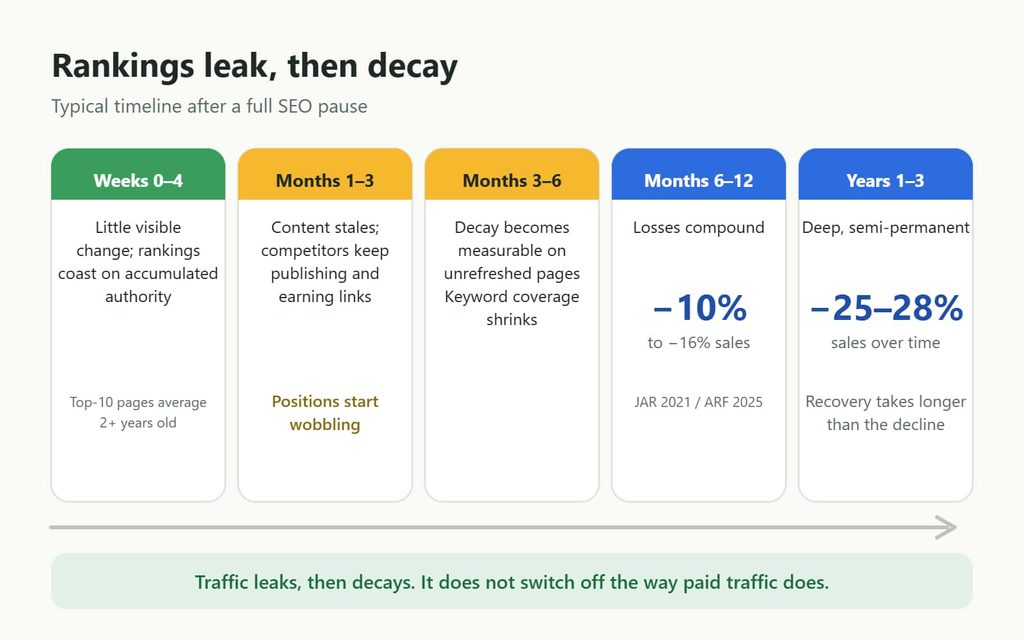
Here’s the typical timeline after a full pause:
| Timeframe | What usually happens | Evidence |
|---|---|---|
| Weeks 0–4 | Little visible change; rankings coast on accumulated authority | Ahrefs: top-10 pages average 2+ years old |
| Months 1–3 | Content stales; competitors keep publishing and earning links; positions start wobbling | Ahrefs decay guidance |
| Months 3–6 | Decay becomes measurable on unrefreshed pages; keyword coverage shrinks | Ahrefs/Frase decay data |
| Months 6–12 | Losses compound; sales effects mirror “going dark” (−10% to −16%) | JAR 2021 / ARF 2025 |
| Years 1–3 | Deep, semi-permanent losses (−25% to −28%); recovery takes longer than the decline | JAR 2021 / ARF 2025 |
Two other facts tighten the picture. The first: 96.55% of all pages get no traffic from Google at all, per Ahrefs’ 2023 study. Whatever traffic you’re getting is concentrated in a small, hard-won slice of your site. A pause puts that slice directly at risk. The second: the empty space doesn’t stay empty. The brands that keep publishing during your pause pick up the rankings, the links, and the topical authority you stopped defending. So when you eventually restart, you’re not resuming where you left off. You’re rebuilding against an opponent who’s been training while you sat on the bench.
The Long-Term Evidence on Going Dark
The most credible research on what happens when brands stop investing in marketing doesn’t come from SEO vendors. It comes from the advertising research establishment. Hartnett et al.’s “When Brands Go Dark,” published in the Journal of Advertising Research in 2021, tracked what happened to sales when brands halted broad-reach advertising entirely. The ARF replicated the study in 2025 and largely confirmed the shape of the damage.
| Time after going dark | Sales change (JAR, 2021) | Sales change (ARF replication, 2025) |
|---|---|---|
| 1 year | −16% | −10% |
| 2 years | −25% | −20% |
| 3 years | −28% | −28% |
| Brands that grew despite going dark | only 7% |
The mechanism behind that curve is share of voice. Nielsen’s analysis of 123 brands, later popularised by Binet and Field at the IPA, found that a brand spending ten share points above its market share tends to gain roughly half a point of market share per year. Run the mechanism in reverse , pull spending below share , and you get the curve above. A few caveats are worth keeping in mind. Some practitioners who dug back into the underlying data report the correlation is closer to 0.2 in certain datasets, which is weaker than the headline number suggests. So “strong directional tendency” is fair; “law of marketing physics” is overstating it. The 60/40 split between brand-building and activation that comes out of the IPA database (about 996 campaigns between 1980 and 2016) sits in the same category. Binet himself calls it a starting point for an argument, not a rule to memorise.
Paid vs. Organic: Different Physics, Different Risks
A misconception that shows up a lot, especially inside companies that outsource digital marketing, is that SEO can be paused and resumed the way a paid campaign can. The two channels don’t work that way.
Paid ads drive traffic for as long as the budget is flowing. Pull the budget, traffic stops, almost instantly. Organic traffic works on entirely different mechanics. You earn position over time through content quality, keyword targeting, and authority-building, and that position starts decaying the moment maintenance stops. The recovery curve is months or years, not hours.
The size of the stakes is different too. BrightEdge’s channel-share research put organic search at 53.3% of trackable website traffic, against roughly 15% for paid and 5% for social. A 2025 SE Ranking study puts organic at 46.98% of all website traffic worldwide. Pick whichever estimate you prefer; either way, organic is the largest single traffic source for most websites.
| Attribute | Paid advertising | Organic SEO |
|---|---|---|
| How traffic is earned | Rented per click | Accumulated over months and years |
| What happens when you stop | Traffic stops immediately | Traffic leaks, then decays on a compounding curve |
| Typical share of website traffic | ~15% | ~47–53% |
| Cost of restarting | Budget resumes, traffic resumes | Rebuild takes months–years; only 1.74% of new pages crack the top 10 within a year |
| Strategic role in a downturn | Instant, controllable demand capture | Compounding asset; the substrate for AI search visibility |
One nuance cuts in organic’s favour. A field experiment by Blake, Nosko, and Tadelis at eBay, published in Econometrica in 2015, found “no measurable short-term value in brand keyword advertising.” When eBay paused its ads on its own brand terms, the traffic shifted almost entirely to its natural search results. The practical reading is straightforward: paid search on your own brand name largely substitutes for organic visibility you already own. If something absolutely has to be cut, brand-term PPC is the cheapest sacrifice. Organic SEO is the worst one.
Why Recessions Reward Marketers, Not Punish Them
The instinct to pull back during a downturn is human. The economics run the other way.
Deleersnyder and colleagues, writing in the Journal of Marketing Research in 2009, studied 37 countries and found that ad budgets rise and fall harder than GDP. Which means competitors are also pulling back, and the media that remains gets cheaper to buy. Steenkamp and Fang, in Marketing Science the same year (2011), found that increasing advertising share during a contraction has a stronger effect on profit and market share than the same increase during an expansion. Van Heerde et al. independently confirmed in JMR (2013) that long-term advertising elasticity rises during downturns. A 2005 survey of 154 senior marketing executives by Srinivasan, Rangaswamy, and Lilien in IJRM reached the same conclusion: proactive marketers consistently outperformed reactive ones in contractions.
The corporate-level evidence is starker. Gulati, Nohria, and Wohlgezogen at Harvard Business School studied 4,700 companies across the recessions of 1980–82, 1990–91, and 2000–02. About 9% of those companies emerged from recession stronger. The winners shared a profile: they cut costs selectively and kept investing in marketing and R&D through the worst of it. Roughly 80% of surviving companies took more than three years to get back to their pre-recession growth rates. So the cost of a panic cut gets paid for years after the downturn ends.
A health warning on the most-quoted statistic. The classic recession-marketing figure , McGraw-Hill’s finding that B2B firms maintaining or increasing ad spend through 1980–85 grew sales 275% versus 19% for cutters , is probably the most abused number in this entire field. The original studies were funded by media sellers, and Gerard Tellis’s review of more than 40 such studies found mixed results and serious methodological problems. It’s fine as an illustration of the pattern. It’s not proof.
History, at least, shows which way panic tends to flow. US ad spend fell 12.3% in 2009 per Kantar Media. Digital ad spend still grew 12% through the 2020 pandemic, per IAB data. Alphabet’s first ever year-on-year revenue decline , Q2 2020, with search dropping from roughly $23B to $21B , recovered within two quarters. The businesses that treated the downturn as a share-grab rather than a siege are the ones that ended up writing the recovery stories.
The 2025–26 Variable: AI Search Has Repriced Visibility
This is where pausing today is riskier than it was in any previous downturn. Visibility is being repriced.
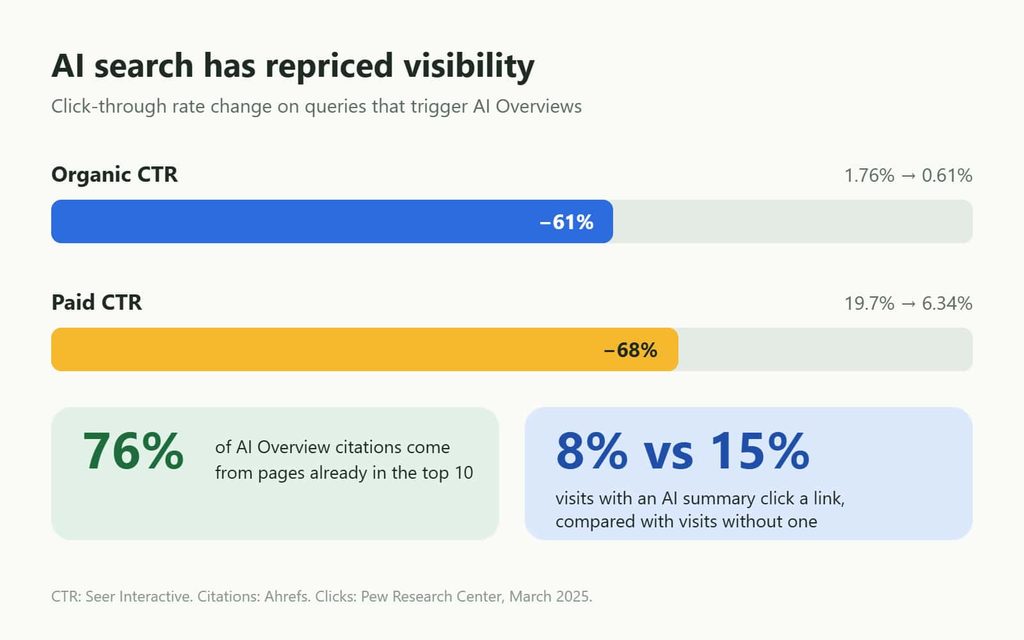
Ahrefs found that AI Overviews reduced the click-through rate of the number-one organic result by 34.5% in April 2025, then revised that figure to −58% in December 2025. Seer Interactive measured organic CTR on queries that trigger AI Overviews falling from 1.76% to 0.61% (a 61% decline), with paid CTR falling from 19.7% to 6.34% (a 68% decline). Pew Research Center reported in March 2025 that roughly one in five Google searches was producing an AI summary, and that users clicked a link in only 8% of visits with an AI summary versus 15% without one. Semrush’s tracking of more than 10 million keywords shows AI Overview prevalence rising from 6.49% of queries in January 2025 to roughly 13% by June, with peaks near 25%.
Here’s the part that matters for the pause decision. Ahrefs reported in July 2025 that 76% of AI Overview citations are pulled from pages already ranking in the top ten. AI visibility isn’t a replacement for SEO. It’s downstream of it. Pause SEO today and you’re not just drifting down page one. You’re falling out of the source material that AI assistants cite. Semrush separately reports that AI-referred visitors are 4.4 times as valuable as the average organic visit. That’s a vendor figure, so discount it as needed, but even discounted, the implication is that AI-era rankings are worth more per click than they used to be, not less.
Beware the hype in both directions. Gartner said in early 2024 that traditional search volume would fall 25% by 2026 because of AI chatbots. That prediction didn’t materialise and was widely challenged. The lesson cuts both ways. Don’t abandon SEO on the strength of AI doom forecasts. And don’t dismiss the CTR effects that are already being measured. Stick with the data, not the hype cycle.
Case Studies: Who Kept Spending, and What Happened
The research has named examples behind it, including one vivid warning.
Hyundai, 2009. While rivals cut budgets, Hyundai’s “Assurance” campaign , letting recession-hit buyers return their cars , drove a 14% year-on-year US sales jump in February 2009, pushed Hyundai’s market share up 38% to 4.3%, and made it the only major automaker to actually grow US sales in Q1 2009. Visibility during the fear was the strategy, not a casualty of it.
Airbnb, 2020. Roughly 90% of Airbnb’s traffic was direct or unpaid, per S&P Global. Its S-1 filing confirms that direct and unpaid traffic actually increased through September 2020. Airbnb has since said it doesn’t intend to return to its old levels of performance-marketing spend. The organic brand equity it defended during the pandemic became its permanent acquisition engine.
Kraft and Domino’s (2008–10) are still the textbook “kept spending, gained share” stories from the financial crisis. We couldn’t independently verify hard spend figures for both, so treat them as illustrative rather than audited.
A warning , HubSpot, 2024–25. Practitioner analyses estimate HubSpot’s blog has lost around 80% of its traffic, somewhere north of 7 million visits, since March 2024. That’s a third-party estimate rather than an audited figure. But the lesson lands cleanly: even the largest content operations in the world aren’t protected by scale alone. Rankings are maintained or lost. They’re never simply held.
How to Cut SEO Spend Without Going Dark
If the budget genuinely can’t hold, the move is restructuring, not switching off. The basic logic of the original advice in this debate still holds: split whatever budget you have between organic SEO and paid advertising, so organic progress continues at a slower pace while paid delivers immediate traffic. During a downturn, that paid traffic is often cheaper to buy, because competitors have left the auctions.
A practical triage looks something like this.
| Cut first | Reduce, don’t eliminate | Protect or increase |
|---|---|---|
| Brand-term PPC (eBay’s experiment showed organic largely absorbs it) | Publishing frequency on non-revenue topics | Quarterly refresh of the pages that actually drive traffic |
| Experimental side-projects and vanity channels | New keyword exploration | Technical SEO health and Core Web Vitals |
| Premium tools you can pause for a quarter | Digital PR volume | Topical-authority content in your core commercial areas |
Three rules make the triage work. Be selective, not exhaustive. Since 96.55% of pages earn nothing, concentrate budget on the small set that does. A smaller, sharper programme beats a broad, abandoned one. Run a quarterly decay audit. Ahrefs’ own guidance treats refresh as scheduled maintenance, not an emergency response. Roughly balance brand and activation. The 60/40 guideline is a starting point to argue with, not a rule to obey. But going 100% short-term activation in a downturn is how brands arrive at the recovery weaker than they entered it.
Four Pitfalls When Budgets Are Tight
- Citing the 275% study as proof. It’s sponsored, methodologically challenged, and 40 years old. The modern evidence , JAR 2021, ARF 2025, Gulati et al. , makes the case better anyway.
- Cutting organic to protect brand-term PPC. The eBay experiment showed brand-keyword ads largely substitute for organic you already own. Protecting them is paying twice for the same traffic.
- Treating AI-search predictions as fact. Gartner’s 25%-decline-by-2026 forecast failed. React to measured data , CTR studies, citation data , not forecasts.
- Assuming you can restart where you left off. With only 1.74% of new pages reaching the top ten within a year, and top results averaging two to three years old, a restart is a rebuild. The cheapest SEO you’ll ever buy is the SEO you keep doing.
Conclusion: Should You Pause SEO?
No. Pause almost anything else first.
The picture the evidence paints is consistent: going dark costs brands 10–16% of sales within a year and 25–28% within three. Only 7% of brands that go dark grow. Organic search remains the largest traffic source for most websites. 76% of AI Overview citations now flow from pages already in the top ten, so the asset you’d be walking away from is more valuable in 2025–26 than it was in any previous downturn. Recessions, counterintuitively, are when marketing elasticity is highest and media is cheapest. The 9% of companies that come out stronger are the ones that cut selectively and kept investing through the worst of it.
The practical next step is a two-hour exercise: pull a list of the pages that actually drive your traffic, move brand-term PPC budget into organic maintenance, schedule a quarterly refresh of your revenue pages, and re-plan the rest of your paid spend around the channels that still convert. If you want a second opinion on where your budget should sit, get in touch , happy to share what’s worked for clients balancing organic and paid through a downturn, and to build something that fits the budget you actually have rather than the one you wish you had.
Sign in to share. Facebook and LinkedIn need the article page to be publicly accessible to show its preview. If an AI cannot open the page, copy the article text from the section above.