
Choose an AI service. ChatGPT and Perplexity submit the summary request, Grok opens it ready to send, and other services open with the request copied as a fallback. If an AI cannot open the page, copy the article text and paste it into the chat.
Getting your Content working in Synergy with your SEO efforts is paramount to your online success. Search engines still drive 53% of all traffic and they do not rank single pages they rank your entity strength and your relative coverage of a topic. Add to that, in the same time AI search went up over 520% which also looks at query coverage, and it makes clear that content really is key with SEO.
In this article we will be talking about content marketing vs SEO and the necessary synergy required between content marketing and search engine optimisation, in order to produce the best possible web pages for your customers and search engines.
Content Marketing vs SEO
SEO and content marketing form one system, not two: search engines rank content, and content only earns visibility through search algorithms and SEO. All Channels reward the same asset, that’s the content that covers a topic completely and matches real search intent. Strictly you could say, Content marketing is writing for your audience alone and SEO is optimizing for the machines that judge your content at the same time.
So, what is SEO content?
Content written with search engine optimization considered as part of the process. For the best success your SEO & content management teams should work together from the very beginning. If you can get this synergy ironed out, with a clear level of communication between departments, it can mean the difference between exponential growth and disappointment.
The working parts of SEO content are basically these 4,
- Keyword research – completed before writing, so you target topics with existing search demand rather than guessing
- Keyword optimization – placing those terms where search engines and readers expect to find them
- Content organization – structuring pages and internal links so visitors and crawlers move logically between related material
- Content promotion – distributing new content through social and link building so it earns visibility beyond publication day
Your SEO consultants will need to pair up with your content writers early on to make sure you are not creating wasteful context. Search algorithms generally measure topical borders and they will differ by index, so DuckDuckGo, Bing, Google, Baidu etc. will all have certain contextual content preferences you must optimize for.
Contrary to popular belief, there is much more to SEO than simply focusing on popular keywords or phrases alone, and in the same breath there is much more to effective content writing than simply creating articles around keywords with high-volumes of traffic. In fact, your keyword analysis should be focused on better understanding your customers and the pain points they have along the customer journey. Your ultimate goal in the early stages is to cover all topics that must be covered to explain what you do as a business or all intent for a query you wish to target.
To elaborate a little on that, let’s say for example one of your clients specializes in Organic Skin Care, focusing on search phrases such as: “Best Organic Skin Care Products”. Semantically speaking skin care products can be broken down into many sub-product types from sunscreen to exfoliants. So do you think you can represent this query type with 1 article or do you write an article for each possible product type? And this is where it ties into what you offer, if you only do sunscreen. Then you might target this cluster by the SPF rating, if it is waterproof, salt-water-proof, sport proof etc.
This will vary from client to client, but aligning your content with what you offer and what users may search related to it is always the goal.
Where the two disciplines overlap
- On-page SEO like titles, headings, internal links, keyword placement is applied to content. The optimization layer has no existence without the content layer underneath it.
- Search is content marketing’s largest distribution channel at 53% of trackable traffic.
- Both disciplines target intent from different instruments: SEO decodes it from query data, content marketing decodes it from audience research. Same target, different methods.
The verdict: content is part of SEO, no matter how you look at it
How SEO Complements Content Development
SEO complements content development by feeding search intelligence into the workflow before a single word gets written, there is a difference between writing something you think is good vs what a machine measures.
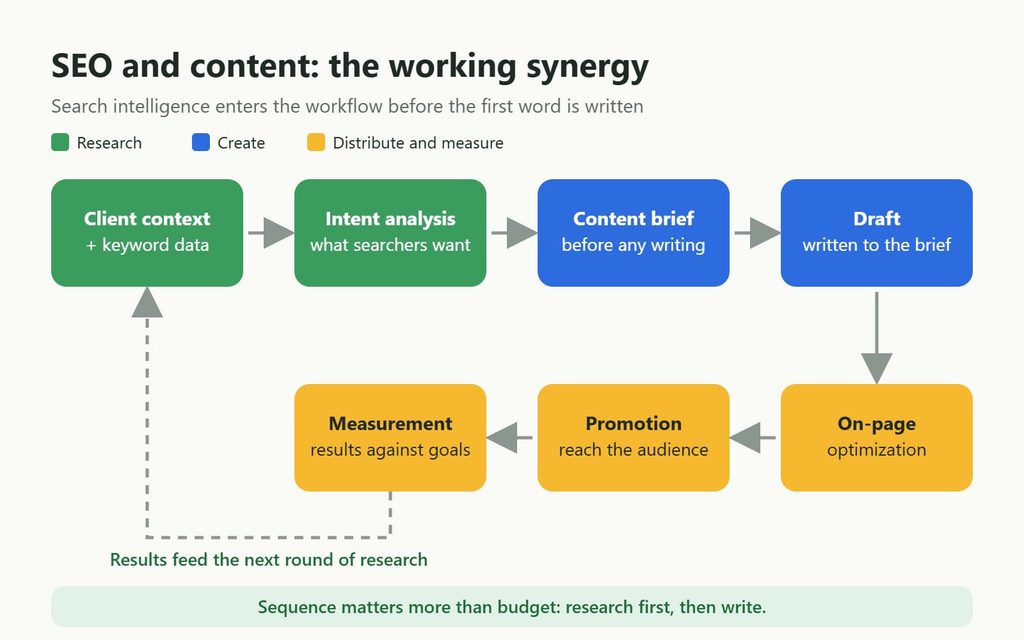
Should SEO and content teams work together from the start?
Yes, pairing your SEO consultants with your content writers before creation decisions have been made separates exponential growth from disappointment. Your consultants hold the client relationship: they understand the business, the market, and the objectives. And they can reverse engineer the results of the target channel. When that context reaches writers at the brief stage instead of the review stage, keyword data and SERP (Search Engine Results Page) context shapes the content.
Why keyword research is customer research
Keyword analysis reveals how your customers search around your product or services and in 2026 how AI agents and chatbots research it too. The query data tells you what people want solved; the volume only tells you how many of them want it solved so you can align with the query path by volume. Prioritize content for high volume terms, but in most cases these need clusters to rank for that are linked together.
How to decode search intent before writing
Take a client in organic skin care targeting “best organic skin care products.” The wrong move: build an article around the phrase and ship it. The right move: interrogate the intent behind it.
- What are these potential buyers actually looking for? Does the SERP show creams or exfoliants first?
- Which problems do they want solved or are highlighted within the SERPs – sensitivity, ingredients, price, ethics?
- What does the phrasing reveal about where they sit in the buying journey? And what does SERPs language tell you about the preferred phrasing of top ranking pages so you can align.
Once you decode the intent or both the user and algorithm, you can create original, tailored articles that hold attention, answer the questions behind the query, and convert interest into sales.
Use content to build a relationship between the client and consumer
It is all too easy to fall into the habit of creating empty content. It may well be written with a number of excellent and well-placed keywords though if it does not engage the customer along their query path (what they type in sequence into google) then it is ultimately a waste. Your content needs to resonate with visitors searches so AIs and search engines retrieve you as the source.
Empty content fails here. It may carry well-placed keywords, but if it doesn’t engage, the click wastes itself and readers who arrive and immediately leave teach search engines nothing good about your entity.
What holds attention instead:
- Relevant, current, useful information – advice, tips, and trending topics that pull traffic in and keep it on site longer
- Demonstrated understanding – content that mirrors the reader’s needs, desires, and problems back at them
- Confidence and assurance – proof that the brand behind the page is informed, prepared, and credible
Where the Synergy Breaks Down: Pitfalls and Edge Cases
The SEO–content synergy fails in predictable ways: keyword-first writing, thin content, and strategies built for a click economy that no longer exists. Data changes and with that algorithm consensus, so stale content also causes issues if not reviewed and improved.
The empty-content trap
Well-placed keywords inside content that doesn’t engage equals wasted production. WordStream’s warning applies directly: thin, low-value content risks Google penalties and produces high bounce and low conversion. Think of this like a threshold you do not want to surpass and once you do you will see ranking penalties and pages being deindexed, content must have purpose and must be interconnected to what you offer.
When ranking no longer means traffic
Roughly 60% of searches now end without a click (Bain & Company, 2025). When Google shows an AI summary, only 8% of users click a traditional result and nearly double, 15%, when no summary appears. And now 88% of queries triggering AI Overviews are informational.
The consequence cuts both ways: rankings alone no longer guarantee visits, but AI systems cite comprehensive, well-structured content. Which inherently raises the value of depth, coverage, and entity strength.
What AI search changes, and what it doesn’t
Google’s AI Overviews now reach 2 billion monthly users, and ChatGPT counts 700 million weekly active users. But AI platforms evaluate the same fundamentals search engines always have: query coverage, entity strength, content quality. Your synergy strategy survives the platform shift intact however the channels multiply.
Next Step: Measure the Citation, Not Just the Rank
The natural extension of the AI-shift question is measurement: track how often AI platforms cite your content, not only where Google ranks it. AI systems due to their probabilistic nature will if asked 10 times create very similar output, but will give you telling detail about intent they prefer for an entity.
Create content that aligns with this intent and measure with tools like mangools, Ahrefs, SEMrush and so on to gauge and optimize your AI performance across a selection of prompts. Or have our team take over your AI optimization and SEO Services for a path to success.
Sign in to share. Facebook and LinkedIn need the article page to be publicly accessible to show its preview. If an AI cannot open the page, copy the article text from the section above.