
Choose an AI service. ChatGPT and Perplexity submit the summary request, Grok opens it ready to send, and other services open with the request copied as a fallback. If an AI cannot open the page, copy the article text and paste it into the chat.
Domain Authority (DA) is a 0 to 100 score created by Moz, a third-party SEO software company, to estimate how likely a website is to rank in search results. It is calculated from link data, and it is not a metric that Google measures, publishes, or uses. That distinction is the answer to the question this article covers: is Domain Authority a Google ranking factor? No. Google has never confirmed DA as a ranking factor, and its representatives have said the opposite. What often gets misread online is a different point about site-wide authority signals leaked by Google in the Content Warehouse API leak in 2024, which this article separates clearly below.
What Is Domain Authority?
Domain Authority is a comparative score, not an absolute grade. Moz builds it from the number and quality of links pointing to a site, so a bigger, better-linked site tends to score higher than a smaller one in the same tool. Three things follow from that:
- It is a prediction, not a measurement. The score estimates ranking likelihood. It does not reflect anything Google calculates.
- It is provider-specific. Moz, Ahrefs, and Semrush each use different link indexes and formulas. A DA of 40 in one tool is not equal to a 40 in another, and the scores are not interchangeable.
- It moves without your site changing. When a provider updates its index, every score shifts. A sudden drop is a tool change, not a penalty.
Is Domain Authority a Google Ranking Factor?
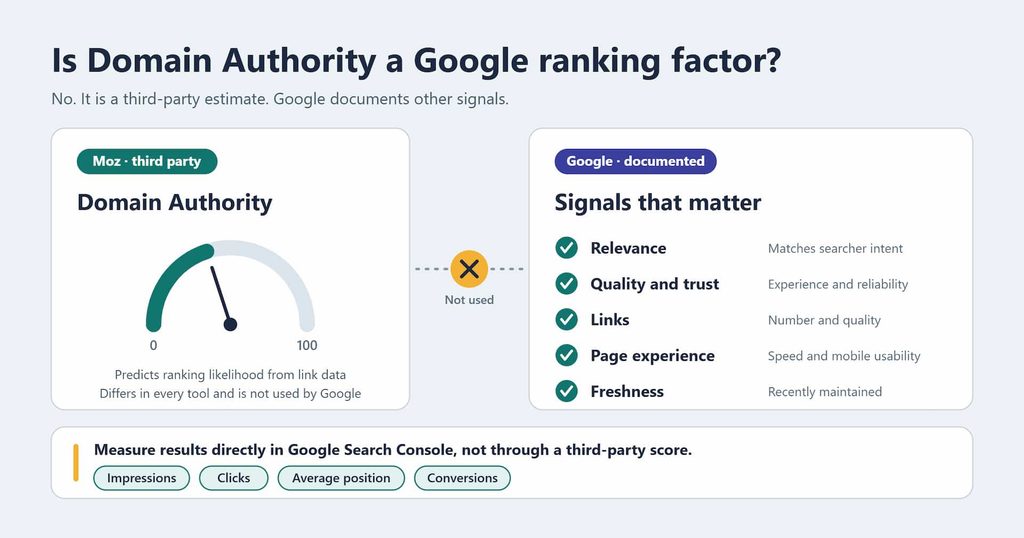
No. Google does not use Domain Authority, or any other third-party authority score, as a ranking factor. Domain Authority is built and owned by Moz. Google has no access to it as a ranking input and does not reference it in its documentation. Despite the old headline that once sat at the top of this page, Google has never confirmed DA as a ranking signal.
What John Mueller Actually Said
The confusion traces back to a comment by Google’s John Mueller about site-wide authority signals. Mueller explained that when Google encounters a newly created page, it has little information about that individual page, so it leans more on signals from the rest of the site to judge it. That is a statement about how Google evaluates new URLs, not a statement that Domain Authority is a ranking factor. Google uses many systems and signals; the score shown by an SEO tool is not one of them.
Site-Wide Authority vs. Domain Authority
These two phrases sound alike and mean different things. Site-wide authority is Google’s internal, unpublished assessment of how much it trusts a domain overall, drawn from links, content, and history. This was leaked in Content Warehouse API documentation and shows one real, named, stored field called siteAuthority. Read more about the leaked details here.
Domain Authority is a public number a third-party tool from MOZ prints on a dashboard. One is a real ranking input you can influence; the other is an estimate you can track. Improving the first is what actually moves rankings, the second should be used cumulatively with other metrics as it can easily be doctored.
What an Authority Score Can Help You Compare
A DA score is still useful, as long as you use it as a relative measure inside one tool. It helps you:
- Compare your site against a competitor in the same tool, at the same point in time.
- Judge whether a referring site’s link profile is stronger or weaker than yours.
- Track the direction of your own link growth over months, not days.
What it cannot do is tell you how Google will rank a specific page. For that, use impressions, clicks, average position, and conversion data from Google Search Console, which is measured directly rather than estimated.
How to Check Domain Authority
Enter your domain into an authority checker such as Moz Link Explorer, Ahrefs Site Explorer, or Semrush Domain Overview. Each returns its own score, so stay inside one tool when comparing. Record the date with the number, because the underlying index changes and the score will drift even if your site does not.
What to Improve on Your Own Website
Since Google does not rank on DA, the goal is to improve the real signals a third-party score approximates. In practice that means steady website housekeeping:
- Publish new content regularly, so the site keeps proving it is active and relevant.
- Pay attention to your internal linking architecture, so authority flows to the pages that need it.
- Keep your backlink profile clean, and disavow or remove toxic links that drag overall authority down.
- Strengthen new pages with internal links, because a fresh URL with no links to it has almost nothing for Google to judge it on.
Google Ranking Factors That Do Matter
Rather than chasing a third-party score, focus on what Google actually documents as relevant. The main areas are:
| Area | What it covers |
|---|---|
| Relevance | How well a page’s content matches the searcher’s intent |
| Quality and trust | Experience, expertise, authoritativeness, and reliability of the site and author |
| Links | The number and quality of other sites linking to your pages |
| Page experience | Loading speed, mobile usability, and absence of intrusive elements |
| Freshness | Whether a page or site has been recently updated or maintained |
Measure Results Directly
The most reliable authority signal you can check is your own performance in Google Search Console. Watch impressions, clicks, and average position for the queries you care about, and let those numbers, not a third-party score, tell you whether your work is landing. If you would rather have a professional handle the technical side, our team builds and maintains authority for clients across Bangkok and Thailand through SEO services and ongoing content marketing.
Sign in to share. Facebook and LinkedIn need the article page to be publicly accessible to show its preview. If an AI cannot open the page, copy the article text from the section above.