
Choose an AI service. ChatGPT and Perplexity submit the summary request, Grok opens it ready to send, and other services open with the request copied as a fallback. If an AI cannot open the page, copy the article text and paste it into the chat.
This guide explains AI concepts and Google’s AI Overviews, including their limitations. AI-generated answers can be useful, but important information should be checked against reliable sources.
A Journey Through the Evolution of Artificial Intelligence
AI’s history traces back to classical philosophers who tried to describe human thinking as a symbolic system. However, the formal foundations were laid in the 1940s with programmable digital computers.
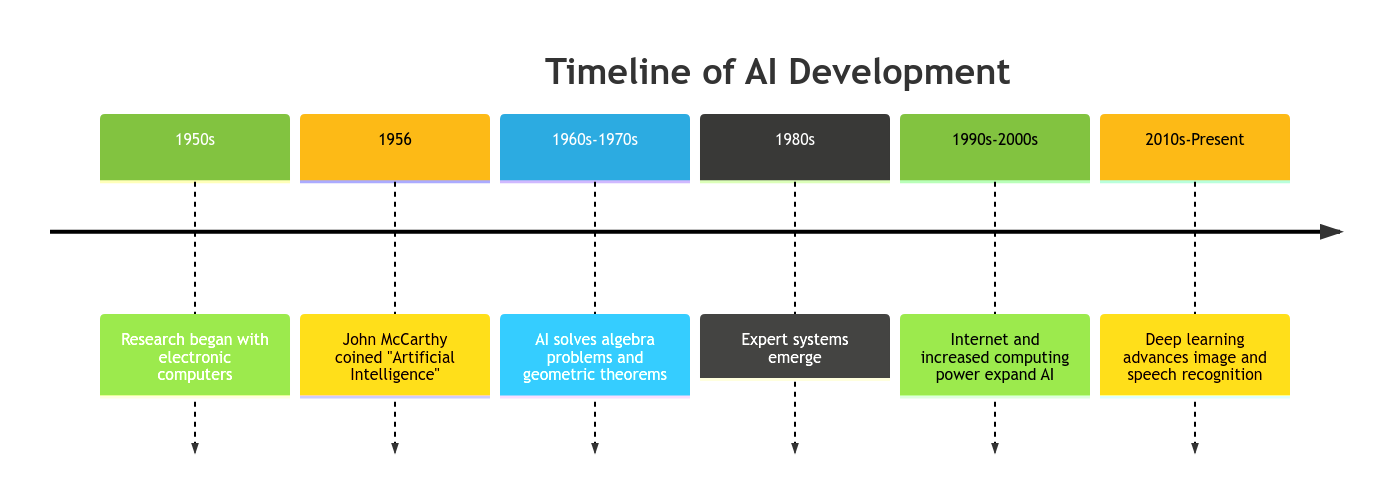
Timeline of AI Development:
1950s: Research began alongside the rise of electronic computers.
1956: John McCarthy coined the term “Artificial Intelligence” at the Dartmouth Conference.
1960s-1970s: AI algorithms could solve algebra problems and prove geometric theorems.
1980s: Expert systems emerged, making decisions in real-life situations.
1990s-2000s: The Internet and increased computing power expanded AI’s capabilities.
2010s-Present: Deep learning leads to advancements in image and speech recognition. LLMs scale to achieve excellent vision and tool use and can perform white collar tasks.
Exploring the Spectrum: Types of Artificial Intelligence
AI manifests in various forms, each with distinct levels of complexity and application potential: Narrow, General, and Superintelligent.
Narrow: Also known as Weak AI, this system is designed for specific tasks. Examples include Siri and Alexa.
General: Known as Strong AI, these systems can understand, learn, and apply intelligence broadly like a human. General AI has not yet been achieved. But latest models have solved 1000 year old math problems and are on track for general intelligence with LLM harnesses.
Superintelligent: This surpasses human intelligence in every field. While still theoretical, its potential emergence raises profound questions for humanity’s future.
Reactive Machines, Limited Memory, Theory of Mind, and Self-aware AI:
Reactive Machines: Perform basic operations (e.g., IBM’s Deep Blue).
Limited Memory: Integrates past experiences (e.g., autonomous vehicles).
Theory of Mind: Understands emotions and thoughts (in research phase).
Self-aware AI: Possesses consciousness and self-awareness (still theoretical, although anthropic will tell you otherwise).
Demystifying Machine Learning and Deep Learning
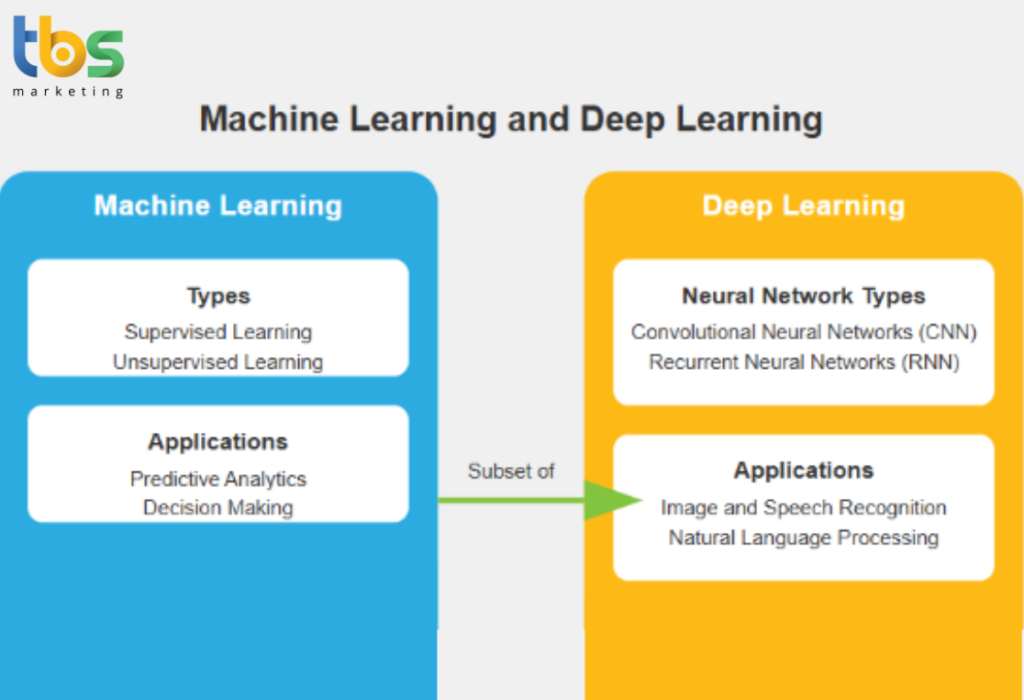
Machine Learning (ML) enables machines to improve at tasks with experience. Algorithms learn from data to make decisions or predictions, with models including supervised, unsupervised, and reinforcement learning.
Deep Learning (DL) uses neural networks to process data in complex, layered models. Algorithms like Convolutional Neural Networks (CNN) and Recurrent Neural Networks (RNN) analyze visual and sequential data with high accuracy.
Machine learning enhances decision-making with predictive analytics, while deep learning recognizes complex patterns, excelling in tasks like natural language processing, autonomous vehicles, and medical diagnostics.
Unveiling Natural Language Processing
Natural Language Processing (NLP) enables machines to interpret, analyze, and respond to human language. It employs algorithms to decode and emulate the nuances of human language. Through syntactic and semantic analysis, NLP systems grasp the meaning and intention behind written or spoken inputs.
NLP facilitates a deeper connection between humans and machines. It enables sentiment analysis, language translation, voice-activated personal assistants, and chatbots, revolutionizing our interactions with technology.
The Evolution of AI in Google Search
The Need for AI Overviews
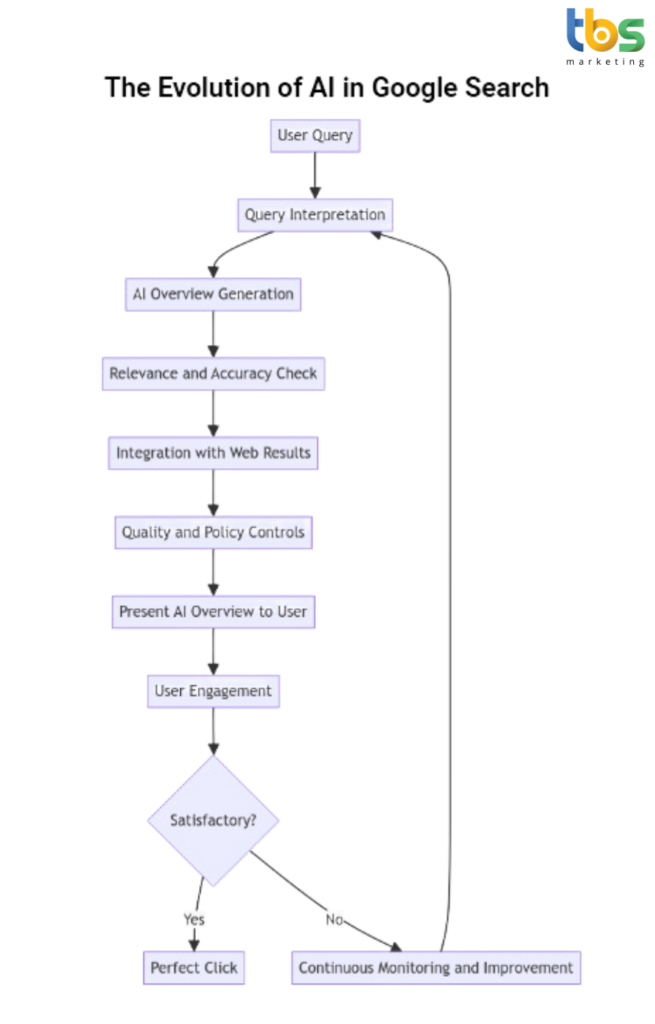
Traditionally, Google Search relied on algorithms to fetch and display the most relevant web pages based on user queries. However, the increasing complexity of user queries necessitated a more sophisticated approach. AI Overviews were introduced to address this need, providing a summarized, accurate response to complex queries while linking to detailed web content. By offering high-quality, relevant links, Google aims to achieve the perfect click, where users quickly find exactly what they’re looking for.
How AI Overviews Work
Unlike traditional chatbots, AI Overviews are integrated with Google’s core website ranking systems to deliver accurate information backed by top web page results. They don’t “hallucinate” answers but may misinterpret nuances or lack comprehensive data. Recent updates address nonsensical queries, user-generated content, and strengthen quality protections, particularly for news and health topics. These advancements aim to ensure AI Overviews provide high-quality, reliable information.
The Functionality of AI Overviews
Query Interpretation: It interprets user queries, including complex and multi-part questions, to provide a coherent summary.
Relevance and accuracy: AI-generated summaries can contain errors even when they reference web results. Supporting links are a starting point for verification, not a guarantee.
User Engagement: By providing high-quality, relevant links, AI Overviews enhance user engagement and satisfaction with search results.
Expanded AI Overview
The sources shown in an AI Overview can differ from the ordinary results for the same query. Do not assume a fixed relationship between organic ranking position and citation. Features and source selection can change, so review the results relevant to your own audience.
Challenges and Criticisms
Initial User Feedback
Since their introduction, AI Overviews have received mixed feedback. While many users appreciate the detailed responses to complex queries, there have been instances of erroneous overviews. These inaccuracies often stem from misinterpreting queries, nuances in language, or a lack of quality content on certain topics.
Erroneous and Misleading Results
Some users reported odd or misleading AI Overviews, which raised concerns about the feature’s reliability. For example, unusual queries like “How many rocks should I eat?” generated overviews linking to satirical content, highlighting the system’s struggle with nonsensical or satirical queries.
Fake Screenshot and Public Perception
The widespread sharing of fake screenshots depicting dangerous or incorrect AI Overviews further complicated the issue. While many of these were easily identifiable as fake, they nonetheless affected public perception and trust in the feature.
Improvements and Future Directions
Technical Enhancements
In response to the feedback and identified issues, Google implemented several technical improvements:
Nonsensical Query Detection: Enhanced mechanisms to detect and exclude nonsensical queries from generating AI Overviews.
Satire and Humor Content Filtering: Limitations on including satirical or humorous content in responses.
User-Generated Content Restrictions: Updated systems to reduce reliance on user-generated content that could provide misleading advice.
Triggering Restrictions: Additional restrictions for queries where AI Overviews were not proving helpful.
Keyword Optimization: Enhancing the use of relevant keywords to ensure the AI Overview aligns closely with the user’s search intent, thereby increasing the chances of achieving the perfect click.
Policy and Quality Controls
Google reinforced its content policies to ensure AI Overviews adhere to high standards of accuracy and reliability. Violations, though rare, are promptly addressed to maintain user trust and safety.
Monitoring and Feedback Integration
Continuous monitoring of user feedback and external reports allows Google to swiftly address issues and make iterative improvements. This proactive approach ensures that AI Overviews evolve to better serve user needs while minimizing errors.
The Impact of AI Overviews on Search

Enhanced User Experience
AI Overviews have significantly improved the user experience by providing more comprehensive and accurate responses to complex queries. Users now spend more time on pages linked from AI Overviews, indicating higher engagement and satisfaction. The focus on delivering the perfect click ensures users quickly find the information they need, making their search experience more efficient and rewarding.
Higher Quality Traffic
The inclusion of relevant links in AI Overviews has led to higher quality web traffic. Users are more likely to stay on the pages they visit from these overviews, reducing bounce rates and enhancing the overall value of search results.
Educational and Informational Benefits
AI Overviews have educational and informational benefits, particularly for complex topics where a concise, accurate summary can save users time and effort. This feature is especially valuable for students, researchers, and professionals seeking quick, reliable information.
Integrating SEO Strategies
To maximize the effectiveness of AI Overviews, integrating SEO strategies is crucial. On-page SEO techniques, such as optimizing meta tags, meta titles, and descriptions, play a significant role in enhancing search visibility. Using relevant keywords within these elements helps search engines understand the content’s relevance to user queries. Crafting compelling meta titles and descriptions encourages higher click-through rates, contributing to the perfect click. Ensuring that these elements are well-optimized can significantly boost the organic ranking of pages included in AI Overviews, improving overall user engagement and satisfaction.
Navigating the Crossroads of AI and Ethics
As AI integrates deeper into society, ethical implications become urgent. Researchers strive to embed ethical reasoning in AI, recognizing these systems’ consequential roles. Privacy concerns emerge as systems adept at processing vast data can inadvertently reveal sensitive information or become tools of surveillance. Algorithms can perpetuate bias if not designed carefully, influencing job recruitment and loan approvals.
AI and the Future of Work
AI automation introduces challenges and opportunities, transforming employment trends. Automation increases productivity by reducing the need for human labor in specific roles while creating new job categories that require digital fluency and AI expertise. Continuous learning and adaptation become essential for job security, with roles focusing on AI ethics, governance, and human-machine interaction expanding as society navigates this technological frontier.
Unveiling the Challenges and Limitations of Artificial Intelligence
AI faces persistent challenges, including data requirements, natural language understanding, and algorithmic bias. Addressing these challenges involves balancing utility and privacy, improving AI’s ability to process and interpret natural language, and implementing fair machine learning practices.
The Role of Big Data in AI

Big Data fuels AI engines, driving advancements and efficiency. Data from social media, IoT devices, and other digital sources feed AI systems, enabling them to learn, adapt, and evolve. Big Data analytics is crucial in training AI models, allowing them to recognize patterns and make predictions.
AI and Robotics: An Integration Transforming Automation
AI enhances robotics, enabling machines to learn, adapt, and function autonomously. Robotic Process Automation (RPA) streamlines workflows by mimicking human actions to execute repetitive tasks, reducing errors and lowering costs. Cognitive RPA integrates machine learning and NLP for complex tasks, pushing the boundaries beyond structured tasks.
The Societal Transformation Through Artificial Intelligence
AI reshapes daily life, enabling more informed decisions and transforming industries. Autonomous vehicles promise safer travel, AI-powered diagnostics aid in disease identification, and personalized learning in education adapts to individual students. Financial services use AI for fraud detection and to personalize banking experiences, while consumers enjoy heightened convenience through AI-curated digital experiences.
AI’s reach extends beyond convenience into critical domains like employment, where job roles evolve and new skill sets are required. Privacy concerns, equitable AI benefits, and bias and inequality are societal challenges that need collaborative resolution.
Peering Into the Horizon: AI’s Evolving Landscape
AI continues to advance, leading to more intuitive and intelligent systems. Google’s AI innovations significantly influence search and information retrieval, making data access more intuitive and personalized. Generative models create text, imagery, and code, raising questions about content authenticity and human creativity.
Web experiences grow increasingly personal, with AI tailoring interactions based on user behavior. The future sees AI enhancing user experiences and transforming expectations, with personalized interactions becoming the norm.
Reflecting on the Journey Through the AI Landscape
AI’s evolution touches every facet of modern life. As AI technologies advance, the need for vigilant oversight remains imperative to ensure beneficial outcomes for humanity. Engage in discussions about AI’s influence, balancing innovation with regulation, and consider how AI integrates into daily experiences.
Conclusion
AI Overviews represent a significant advancement in searches, offering users detailed, accurate responses to complex queries while promoting high-quality web content. Despite initial challenges and criticisms, Google’s ongoing improvements and commitment to accuracy have bolstered the feature’s reliability and user satisfaction. As AI continues to evolve, we can expect further enhancements that will make search engines more intuitive and effective, ultimately transforming how we access and interact with information online. By focusing on keywords and aiming for the perfect click, Google continues to refine the search experience, making it more seamless and user-centric.
About Us
Embark on a transformative journey with TBS Marketing, where innovation in AI-driven digital marketing strategies awaits. Reach out today, and let’s pioneer your business’s path to unprecedented success with cutting-edge AI solutions.
Learn more
To learn how to navigate unpredictable events and AI disruptions, check out this blog on navigating 2027 and beyond: The Future of SEO.
Sign in to share. Facebook and LinkedIn need the article page to be publicly accessible to show its preview. If an AI cannot open the page, copy the article text from the section above.