Choose an AI service. ChatGPT and Perplexity submit the summary request, Grok opens it ready to send, and other services open with the request copied as a fallback. If an AI cannot open the page, copy the article text and paste it into the chat.
Attracting guests is not just about having a great website; it is also about ensuring that your site appears high up in search engine results. Hospitality businesses that don’t invest in SEO are missing out on a huge opportunity to reach potential guests. With AI now taking on a lot of research too and agents and chatbots using various search indexes like DuckDuckGo, Bing, Google or APIs like Tavily, SERPapi and so on. Multi-channel SEO is really the trend for hospitality and semantics play a key role is performance.
Why Hospitality Businesses Need SEO in the Age of AI Search
Before a guest chooses your hotel, a search engine, travel platform, or AI assistant may already have narrowed the options. If your property does not make that shortlist, the guest may never reach your website, see your rooms, or discover why you are a better fit.
That is why hospitality businesses need to take SEO seriously. Search visibility now includes the information people encounter through conversational search and AI-assisted travel planning, alongside Google results, Maps, online travel agencies, and review platforms.
A beautiful website remains useful. But your website sits inside a much larger discovery process. Hotels, resorts, restaurants, and other hospitality businesses need a clear, credible presence wherever guests research, compare, and verify their options. The commercial challenge is to be discoverable, accurately represented, and easy to book.
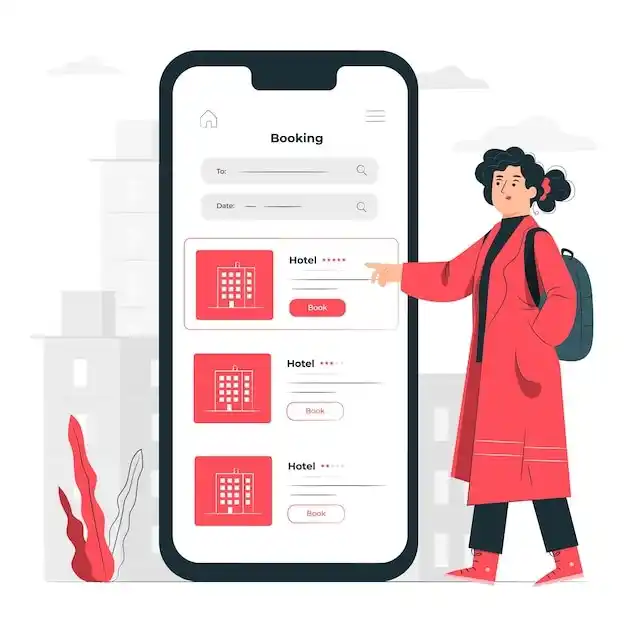
AI is changing who does the filtering
A traveller can ask an assistant for a quiet hotel near public transport, suitable for a family, with breakfast and reliable Wi-Fi. That request combines location, amenities, guest experience, and practical constraints. Your property needs more than a generic claim that it offers an unforgettable stay.
Booking.com’s 2025 Global AI Sentiment Report surveyed 37,325 people across 33 markets. It found that 89% wanted to use AI in future travel planning, but only 12% were comfortable with AI making decisions independently. These are survey responses about attitudes, not a measurement of autonomous bookings.
Expedia Group’s April 2026 research, conducted by YouGov among more than 5,700 adults across the US, UK, and India, found that 68% preferred booking with a trusted travel brand over AI chatbots or agents. Its US and UK findings also showed search engines and OTAs remaining established planning channels.
The opportunity is therefore broader than waiting for guests to hand over every decision. AI can help them identify options, compare neighbourhoods, interpret information, and refine a shortlist while they retain control over the booking. A property that is poorly represented during those stages has a visibility problem before its sales pitch begins.
AI-assisted booking is already a real product capability
Google documents hotel booking within AI Mode through booking partners. As checked for this update, the feature is limited to the US, English, and selected properties, with eligibility requirements. Booking.com has also announced accommodation browsing within ChatGPT, followed by a handoff to its platform when users are ready to select and book. Availability varies; neither development means every guest can book every hotel through an agent.
For hospitality businesses, the practical question is straightforward: when a service searches for a property matching a guest’s needs, does it have accurate information about yours, and can the guest take the next step?
Hospitality visibility reaches beyond your own website
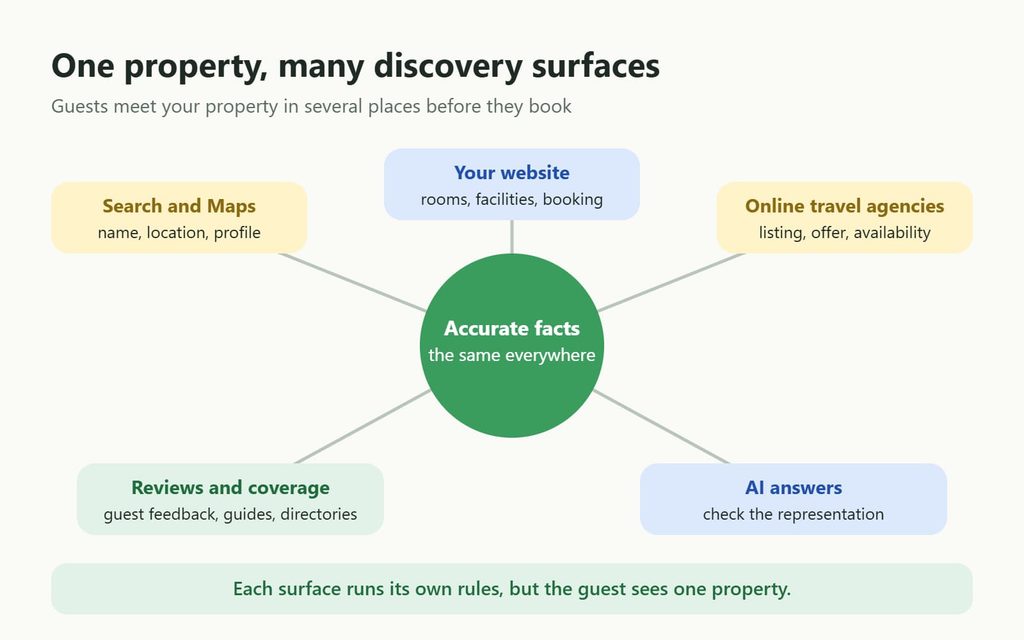
A useful hospitality SEO strategy coordinates several different surfaces. Their ranking systems are not interchangeable, but the guest experiences them as parts of the same journey.
Your website: explain what you actually offer
Publish clear room descriptions, facilities, location details, policies, and reasons to book directly. Give guests enough information to decide whether the property fits their trip. Keep the booking path usable on a phone and make contact details easy to find.
Search and Maps: help people find the business
Maintain the correct business name, location, category, contact details, and relevant profile information. Google says local results mainly depend on relevance, distance, and prominence. It also says more reviews and positive ratings can help local ranking. Those statements concern Google’s local system, not a universal formula for every chatbot.
OTAs: compete inside another marketplace
Booking.com, Expedia, and other online travel agencies provide their own search and recommendation systems. Your listing, availability, offer, and performance within that marketplace need attention alongside your website. Improving a page title on your own site does not directly set your OTA position.
Reviews and independent coverage: support your claims
Guest reviews, destination guides, relevant directories, and editorial lists provide information outside your control. Audit what they say about the business. Look for inaccurate facts, outdated descriptions, and meaningful gaps in coverage. Prioritise sources that are relevant to your target guests rather than chasing mentions everywhere.
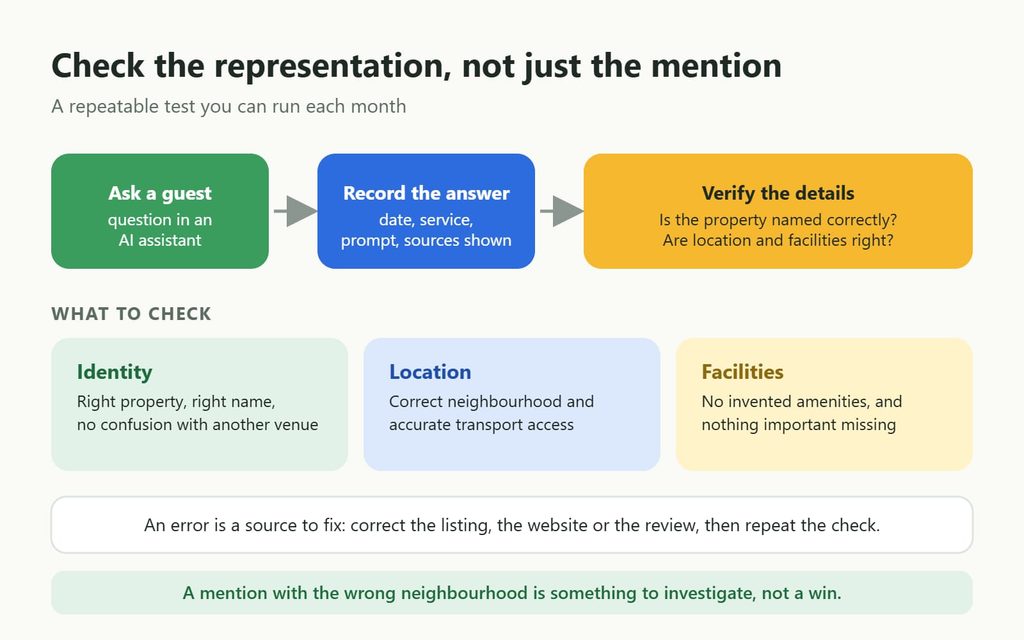
AI answers: check the representation, not just the mention
Test whether assistants identify your property correctly and describe its location, facilities, and suitability accurately. Record the sources they show. A mention accompanied by the wrong neighbourhood or an invented amenity is something to investigate, not a marketing success.
Reviews are part of the information guests and platforms assess
The original article recommended highlighting positive reviews. That remains useful, but it addresses only the presentation of praise. A stronger approach treats review management as part of the guest experience and the information available about the property.
Booking.com describes tools that retrieve answers from property listings, reviews, and photos. Its announcements also describe review summaries and subsequent AI developments. Google’s local-ranking guidance separately identifies review volume and positive ratings as relevant signals. Together, these examples show why review information deserves attention across discovery channels. They do not establish that every AI assistant reads the same reviews or weights them identically.
Consider a hotel positioning itself as a quiet retreat. If guests repeatedly report road noise, the marketing team should work with operations to understand the issue. Better wording cannot make an unsuitable room quiet. Resolve the cause, explain limitations honestly, and monitor whether later feedback reflects the improvement.
Use a consistent process to invite genuine feedback within each platform’s rules. Respond constructively, investigate recurring complaints, and keep a record of the action taken. Review themes such as cleanliness, sleep quality, Wi-Fi, breakfast, and staff support can also help identify what guests need explained before booking.
OTA rankings matter, but they are not a simple quality league table
Booking.com says its default accommodation order considers click-through rate, gross bookings, and net bookings. It explains that factors such as review scores, availability, pricing, policies, and content quality affect those outcomes; commercial arrangements and personalisation can also influence ranking.
Expedia Group describes search relevance, offer strength, guest experience, and visibility tools as influences on marketplace placement. That gives hoteliers useful areas to manage, but does not create a fixed recipe for appearing first.
Use each platform’s reporting to diagnose the problem. Does the property have availability for the intended dates? Are the correct room types and amenities listed? Does the offer make sense for the target guest? Do photographs and policies support a confident booking?
Maintain a balanced distribution strategy. OTAs can provide access to demand, while an effective direct website gives guests another booking route and a place to verify the property. Compare the contribution of each channel after its relevant costs. More bookings through one channel do not automatically mean better commercial performance.
An important distinction: ranking well inside an OTA does not guarantee a recommendation from an independent AI assistant. These are different systems. Coordinate the work because the guest journey connects them, not because one ranking mechanically controls all the others.
Third-party lists and local authority deserve deliberate attention
Ask where a prospective guest would look to validate your property. For a hotel, that might include destination guides, convention information, transport guidance, or a reputable publication covering the area. A restaurant might need accurate menu and reservation details across relevant local discovery services.
Choose coverage based on fit. A family hotel should be able to substantiate its facilities for children. An accessible property should describe actual access arrangements precisely. A city hotel near a station should explain the route and any practical limitations instead of relying on the vague phrase “centrally located.”
Build relationships around information worth publishing: a distinctive experience, useful local expertise, or a genuinely relevant service. Keep factual listings current and distinguish paid placements from independent editorial recommendations. Neither a directory submission nor an appearance in a “best hotels” article guarantees an AI citation.
Your website should answer the questions a shortlist depends on
A traveller does not book an adjective. They book a room, meal, experience, or location that meets particular needs. Replace unsupported superlatives with information a guest can use.
For accommodation, consider questions such as: which room types connect, when breakfast is served, whether late arrival is possible, what parking costs, and whether step-free access covers the route to the room. Give precise, verified answers and explain exceptions.
Here is an illustrative content improvement, not a description of a real hotel: replace “perfect for business travellers” with confirmed details about desk space, meeting facilities, Wi-Fi, early breakfast, and transport access. The guest can then judge suitability instead of trusting a label.
Use the questions received by reception and reservations to prioritise content. Put important answers on the relevant room or facility page as well as in a useful FAQ where appropriate. Do not bury the only description of a facility in an image, brochure, or old announcement.
If a policy changes, update the website and the listings that repeat it. Assign an owner for maintaining property facts. A published answer is only helpful while it remains accurate.
The SEO foundations still apply to AI search
Google says its established SEO best practices remain relevant to AI Overviews and AI Mode. Its guidance requires supporting pages to be indexed and eligible for a search snippet, but does not promise inclusion. It also says no special AI schema or new AI text file is required for these features.
For a hospitality website, review whether key pages can be accessed and found, whether important details appear as readable text, and whether links make the site understandable. Check the mobile experience and the route from a room page to a booking. Use appropriate structured data that agrees with visible information.
Keep responsibilities distinct. Website SEO, profile management, review operations, OTA merchandising, and booking-system integrations overlap commercially, but they are different tasks. An agent’s ability to complete a live reservation also depends on the services and booking partners available to it. Publishing an FAQ alone cannot create that transaction capability.
A practical 90-day plan for hospitality visibility
Days 1-30: establish the facts and find the gaps
Audit the website, primary business profiles, priority OTA listings, review themes, and relevant third-party coverage. Create an approved record of core property facts. Identify contradictions and missing information. Check technical access to key pages and record current bookings, enquiries, and visibility by channel.
Days 31-60: improve the information and the experience
Fix inaccurate listings and weak room or facility descriptions. Answer recurring guest questions, improve mobile booking friction, and give operational teams ownership of repeated complaints. Review OTA availability and listing completeness. Seek relevant local coverage where you have a credible reason to be included.
Days 61-90: measure and refine
Compare changes in relevant search traffic, enquiries, booking completion, and channel performance. Repeat a defined set of AI discovery checks, recording the service, date, prompt, property mentioned, factual accuracy, and cited sources. Use patterns to guide further work, rather than treating one answer as a permanent ranking.
Measure discovery, trust, and bookings together
A useful report should connect visibility with business outcomes. Track non-brand search demand alongside brand searches, relevant landing pages, direct booking enquiries, completed reservations, and conversion problems. Compare direct and intermediary channels with their costs and cancellations in view.
For AI visibility, Bing Webmaster Tools provides an AI Performance report for supported Microsoft and partner experiences, with citation and page-level information. Its October 2026 Topics Portfolio beta adds topic-based analysis. This is a source-specific view, not a measure of all assistants or proof that citations caused bookings.
Google currently includes AI-feature traffic within Search Console’s Web reporting. Supplement that with referral and booking data where available, while acknowledging incomplete attribution. A guest may encounter a recommendation, verify it elsewhere, and later book through another channel.
What should you expect from a hospitality SEO agency?
Ask for a plan that covers the property website and its wider discovery presence. The agency should explain what it will change, what evidence supports the work, which platforms it can influence, and how it will measure results.
Expect collaboration with reservations, revenue management, and operations. Marketing cannot independently correct room availability, service failures, or an inaccurate cancellation policy. Those responsibilities need named owners.
Look for clear reporting and realistic commitments. Be cautious of guarantees to rank first in a chatbot or promises that one technical addition will make agents book your property. Ask to see examples of verified improvements and the limits of the evidence.
Make hospitality visibility a business priority
If guests and digital services cannot establish where you are, what you offer, and why they should trust you, a polished website has limited opportunity to persuade them. Hospitality SEO needs an ongoing owner, a realistic budget, and coordination across the channels guests use.
TBS Marketing can help assess your hospitality website and wider search presence, identify gaps, and build a plan around the guests you want to attract. Explore our hotel marketing services or contact the team to discuss your property.
When did you last check the full journey from a guest’s first question to the information they see about your business?
Sign in to share. Facebook and LinkedIn need the article page to be publicly accessible to show its preview. If an AI cannot open the page, copy the article text from the section above.