Choose an AI service. ChatGPT and Perplexity submit the summary request, Grok opens it ready to send, and other services open with the request copied as a fallback. If an AI cannot open the page, copy the article text and paste it into the chat.
SEO helps a brand build search visibility, bring relevant visitors to its website and create more opportunities to convert. Useful content can also demonstrate expertise and give people a reason to trust and share a brand.
To leverage SEO effectively, connect four practical tactics: earn relevant backlinks, link your own pages thoughtfully, use Facebook to reach and engage your audience, and optimize images. Each supports a different part of search performance. None replaces useful content or a well-built website.
1. Link Building: Earn Relevant, High-Quality Backlinks
Links from other websites can help search engines discover pages and assess how they relate to other content. But link building is not a numbers game: a handful of relevant, editorially earned links is a better goal than a large collection created through manipulative tactics.
Buying or selling links to influence rankings, spamming comments, overusing exact-match anchor text and arranging excessive link exchanges can put a site at risk of search-engine penalties and ranking drops. Focus instead on publishing material that a relevant site would have a genuine reason to reference.
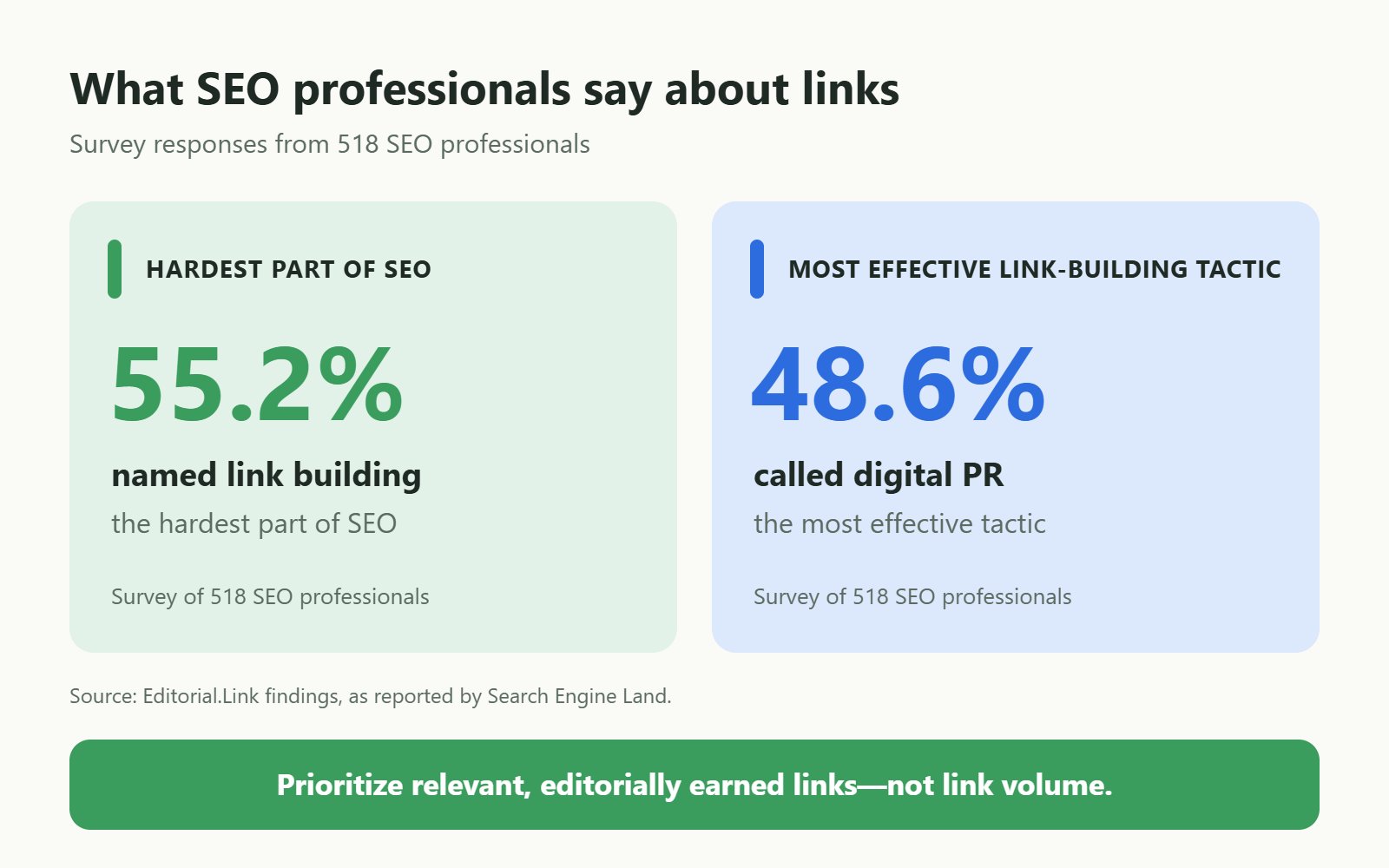
Link acquisition takes work. In a survey of 518 SEO professionals, 55.2% named link building the hardest part of SEO. In the same survey, 48.6% called digital PR the most effective link-building tactic, according to Editorial.Link’s findings reported by Search Engine Land.
A practical way to earn links
- Choose a link-worthy topic. Create a useful guide, original resource, expert commentary or clear explanation that serves a specific audience.
- Find relevant prospects. Look for publications, organizations and creators that cover the topic or link to comparable resources. Prioritize fit over a site’s perceived authority alone.
- Make a personal, useful pitch. Explain what the resource offers their readers. Do not demand a link or disguise a paid placement as an editorial recommendation.
- Track outcomes. Record the pages you pitched, responses, links earned and relevant referral visits. Use the results to improve future outreach.
Digital PR can support this process by bringing a useful story or resource to the attention of journalists and publishers. The goal is not to manufacture mentions; it is to give the right people something worth citing.
2. Internal Links: Help People Find New Pages
Internal links connect pages on your own website. When you publish a new page, link to it from relevant, established pages so visitors can find it and search engines can discover it. A clear site structure also helps both groups move between related topics.
Internal links can support navigation and show how pages relate, but they do not guarantee rankings. Ahrefs’ analysis of the top one million U.S. keywords found a Spearman correlation of 0.117 between internal inlinks and rankings. Ahrefs cautions that correlation does not establish causation.
There is room to make linking more useful: the HTTP Archive’s Web Almanac SEO chapter reports a median of 43 links to the same site per desktop page and 39 per mobile page. Treat those figures as context, not a target to copy. Add a link when it helps someone take a logical next step.
Build a useful internal-link path
- Identify established pages that already cover the new page’s subject.
- Add contextual links from those pages using concise, descriptive anchor text.
- Link the new page to relevant guides, categories or supporting resources.
- Check that important pages are reachable through clear navigation, parent pages or related-content links.
Review links when you update or remove pages. Replace broken links, and avoid repeating the same keyword-heavy anchor text everywhere. The aim is a structure that makes sense to readers, not an artificial pattern built to influence rankings. Our guide to anchor text and good practices provides more detail. The practical test is simple: can a visitor move from the explanation to the next useful answer without guessing?
3. Facebook Activity: Use Engagement to Reach People
Choose social channels based on where your audience spends time. Facebook may be a useful part of that mix: in SE Ranking’s sample of 63,987 websites tracked from January through August, Facebook accounted for 76.56% of social-media referrals. That finding describes referral traffic in the sample; it does not show that Facebook activity directly improves Google rankings.
Use the platform to put useful content in front of people who may read, discuss or share it. A post can bring visitors to a page and create opportunities for engagement or conversion. Shares and comments can indicate audience interest, but they are not a guaranteed ranking factor.
Make Facebook posts useful, not just frequent
- Adapt the post to the audience and the platform rather than pasting a page title without context.
- Explain why the content is useful and make the next step clear.
- Invite genuine discussion when a question would help readers respond.
- Review referral visits and meaningful actions, not just likes or comments.
Keep Facebook in proportion to the wider SEO plan. If your audience is more active elsewhere, prioritize the channel that helps you reach them. Social distribution can support visibility and traffic, but it cannot substitute for a relevant page that meets the visitor’s needs.
4. Image Use: Make Visual Content Clear and Efficient
Relevant images can help explain a page, make information easier to scan and support a better user experience. Search engines can also interpret images and their surrounding page context. Treat image optimization as one part of a complete page, not as a replacement for useful text, sound technical SEO or relevant content.
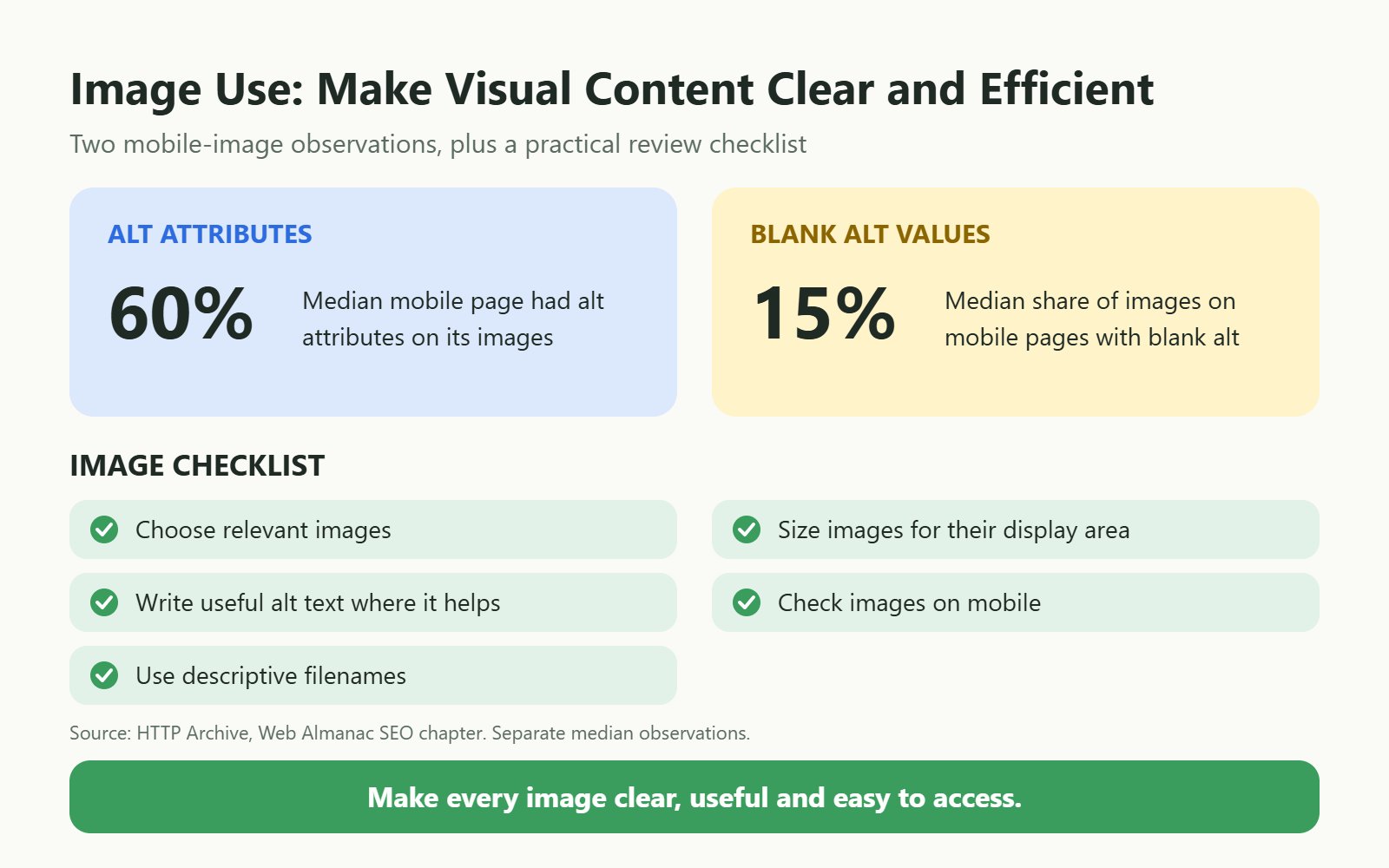
The HTTP Archive’s Web Almanac SEO chapter found that the median mobile page had alt attributes on 60% of its images; the same report found that a median 15% of images on mobile pages had blank alt values.5 These figures highlight an opportunity to review image descriptions, while recognizing that not every image needs descriptive alt text.
Image optimization checklist
- Use relevant images. Choose visuals that support the subject instead of adding decoration that distracts from it.
- Write useful alt text. Describe an image’s purpose or meaningful content for people using assistive technology. For purely decorative images, use an empty alt value rather than repeating nearby text.
- Name files clearly. Use a concise filename that describes the image, rather than a string of unrelated keywords.
- Size images for the page. Provide dimensions appropriate to their display area and compress files to avoid unnecessary page weight. Check the result on mobile as well as desktop.
- Keep image and page aligned. Make sure the visual matches the surrounding copy and adds information or context.
After publishing, check that images display correctly, load at an appropriate size and have alt text where it helps users. Strong visual search potential starts with accurate, accessible images and a page that answers the visitor’s question.
FAQ: How to Leverage SEO
What does it mean to leverage SEO?
It means using practical search tactics to improve how people discover and use your site. This article focuses on earning backlinks, connecting pages with internal links, distributing content through Facebook and optimizing images as part of a wider SEO plan.
Do backlinks still matter for SEO?
Relevant backlinks can contribute to search visibility and help people discover your content. When considering how PageRank affects link building, prioritize links earned because your page is useful, and avoid buying or spamming links to manipulate rankings.
Does Facebook engagement directly improve Google rankings?
The evidence cited here supports Facebook’s role as a source of social-media referrals, not a direct ranking benefit. Use engagement to reach people and encourage relevant visits, without treating likes or comments as a ranking guarantee.
How should I link to a new page?
Add contextual links from established pages that cover related subjects. Use clear anchor text and good SEO practices and make sure the new page also links to genuinely useful supporting content; a sitemap can help establish a clear site structure.
What should I optimize first on an image?
Start with relevance, useful alt text where appropriate, a descriptive filename and dimensions suited to the page. Then check that the image displays well on mobile and does not add avoidable page weight to improve website speed and performance.
Sign in to share. Facebook and LinkedIn need the article page to be publicly accessible to show its preview. If an AI cannot open the page, copy the article text from the section above.