Choose an AI service. ChatGPT and Perplexity submit the summary request, Grok opens it ready to send, and other services open with the request copied as a fallback. If an AI cannot open the page, copy the article text and paste it into the chat.
A logo helps people recognize your business. A brand shapes what they think and feel when they encounter it. A polished visual can inspire admiration, but your brand also comes through in your promises, products, service, language, and every customer interaction.
Build those parts deliberately, and your logo becomes one element of a coherent identity rather than the whole strategy. Use these seven steps to define your brand and apply it consistently.
Looking to insert a logo? Searches such as “insert logo,” “add logo here,” “company logo here,” “insert company logo,” and “insert client logo” usually call for instructions specific to a website, document, or design app. For WordPress use the customize theme settings to adjust the header and add your logo.
1. Understand Your Target Audience
Start with the people you want to reach. Learn what they need, what they value, what frustrates them, and how they choose between alternatives. Customer interviews, support questions, reviews, and sales conversations can reveal useful patterns. Separate what people actually say and do from assumptions your team has made.
Audience insight helps you shape both your brand and your products or services. Adyen reports that 36% of consumers expect personalized recommendations or experiences based on their shopping behavior. Use that as a prompt to ask how your business can make interactions more relevant, not as a reason to personalize without understanding customer preferences.
2. You’ve Got Your Logo. Now Get a Tagline
A tagline gives customers a quick sense of what your business stands for or offers. Keep it clear, distinctive, and believable. It should support your positioning, not promise something your service cannot deliver.
Test a few options with people who match your audience. Ask what each line makes them expect and whether they can recall it later. A Wharton School research paper by John McCoy and Ada Aka analyzed 351,404 slogan-recognition judgments and 175,620 brand-recall judgments across 929 real slogans. That research shows how slogans can be studied for recognition and recall; it does not mean a clever tagline alone will build a strong brand.
3. Research Competitors and Find Your Position
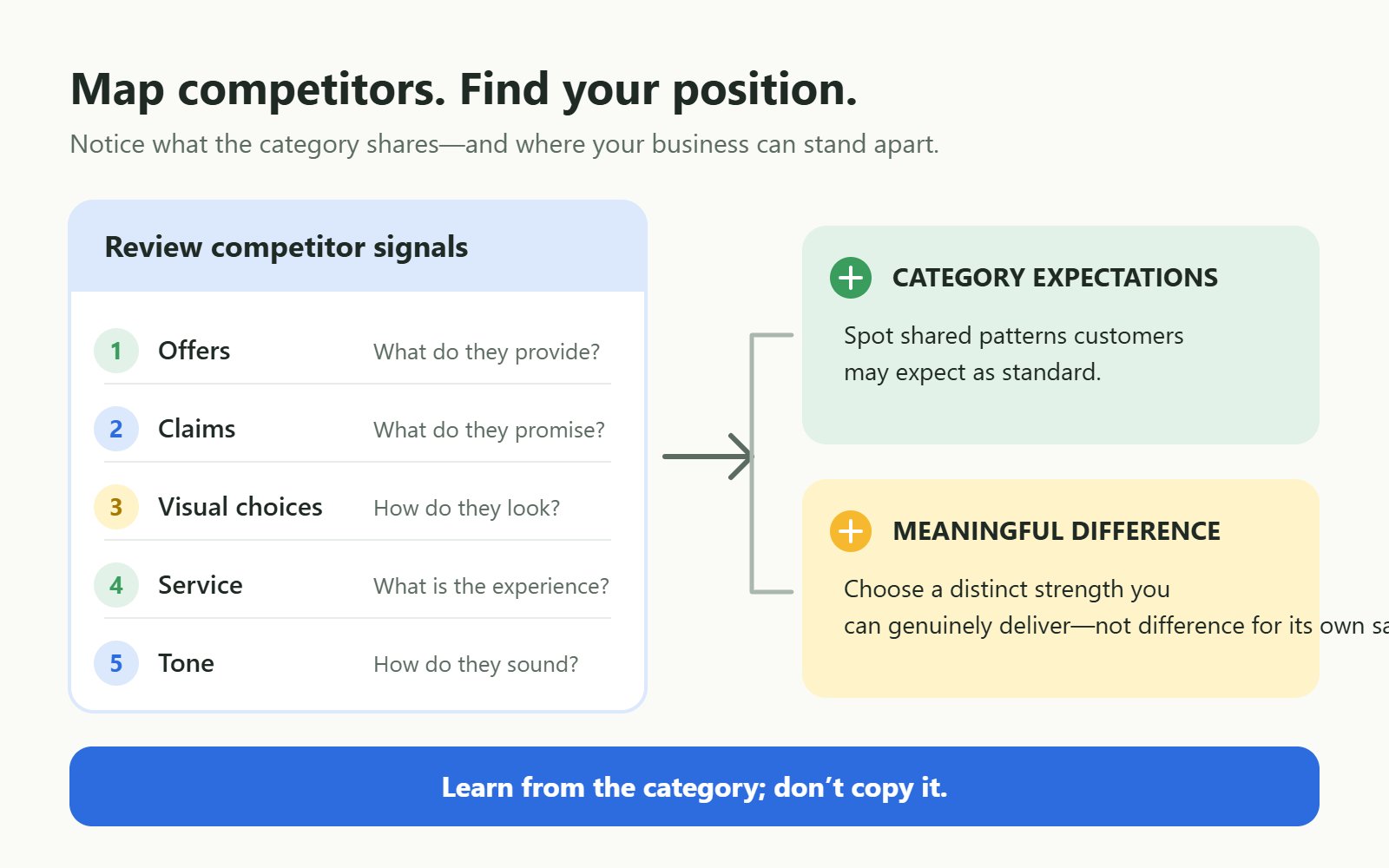
Review the businesses your customers already consider. Compare their offers, claims, visual choices, service experience, and tone. Look for shared expectations in your category, then identify where your business can offer a meaningful difference.
Competitor research helps you evolve an idea; it does not require copying another brand or being different for its own sake. YouGov’s Best Global Brands ranking drew on more than 1 million customer surveys across 28 markets. That scale illustrates the value of customer perceptions in brand research. For a small business, focused conversations and a clear competitor review can be a practical starting point.
4. Choose a Consistent Brand Voice
Decide how your business should sound: expert and formal, friendly and playful, or direct and practical. Then write a short set of voice guidelines. Include a few traits, words you use, words you avoid, and examples of how the voice adapts in a customer email versus a social post.
Your voice shapes how people perceive the brand. Consistency does not mean repeating the same sentence everywhere; it means keeping the same character while adjusting the format to the channel.
5. Write a Short Brand Pitch
Use a few sentences to explain who you serve, what you provide, and why customers should pay attention. Bring together your audience insight, positioning, and voice. For example: “We help [audience] solve [need] with [offer]. Unlike [alternative], we [specific difference].” Replace every bracket with a concrete, supportable detail.
Share the pitch with a colleague or customer. If they cannot explain what you do after hearing it, simplify the wording.
6. Apply the Brand Across Your Business
Make your positioning, voice, and visual choices work together across your website, packaging, social accounts, email, sales materials, and customer service. A logo is one visible asset; clear messaging and a consistent experience make the wider brand recognizable.
| Brand element | What it does | Practical check |
|---|---|---|
| Logo and colors | Support visual recognition | Are they used consistently and legibly? |
| Tagline and messaging | Explain your promise and position | Do they match what you deliver? |
| Voice and service | Shape the customer experience | Does the same brand character come through? |
Treat the brand as the glue connecting these touchpoints. Review key materials together, fix mismatched claims or styles, and give staff simple guidance for customer-facing communication.
7. Advocate for the Brand Over Time
Talk about what your business does and why it matters through useful, honest communication. Let employees explain the brand in their own words while keeping its core promise intact. Ask customers whether the experience matches what your marketing says.
Recognition takes repeated, consistent exposure. Keep listening, refine what no longer fits, and avoid changing your message so often that customers cannot tell what your business stands for.
Frequently Asked Questions
Is a logo the same as a brand?
No. A logo is a visual identifier. A brand includes the associations, expectations, and feelings people connect with your business, shaped by its messaging and customer experience. Explore TBS branding services here.
What should a small business define first?
Begin with your audience and the problem you solve. Those decisions guide your positioning, tagline, voice, and visual choices.
How long should a brand tagline be?
Keep it brief enough to understand and remember, but prioritize clarity over an arbitrary word count. Test whether your intended audience understands the promise.
Where should I insert a company or client logo?
The steps depend on the app or platform. Use a tutorial for that specific tool to learn how to insert a company logo or client logo; this guide focuses on building the brand behind it.
How can I check whether my brand is consistent?
Compare your website, social posts, sales materials, packaging, and customer communications, including digital storytelling to boost your company’s story. Check whether they express the same promise, voice, and visual identity.
Sign in to share. Facebook and LinkedIn need the article page to be publicly accessible to show its preview. If an AI cannot open the page, copy the article text from the section above.