

Choose an AI service. ChatGPT and Perplexity submit the summary request, Grok opens it ready to send, and other services open with the request copied as a fallback. If an AI cannot open the page, copy the article text and paste it into the chat.
Unique content is material that no one else has published in the same form: original insight, first-hand experience, or a perspective readers cannot get from a rewritten summary. Regular content is the same output delivered on a predictable schedule, so an audience learns when to expect it and search engines see a site that is actively maintained. This article covers five practical ways to produce both at once, creating content that is genuinely original and steady enough to keep an audience engaged over the long term.
Why Unique and Regular Content Matters
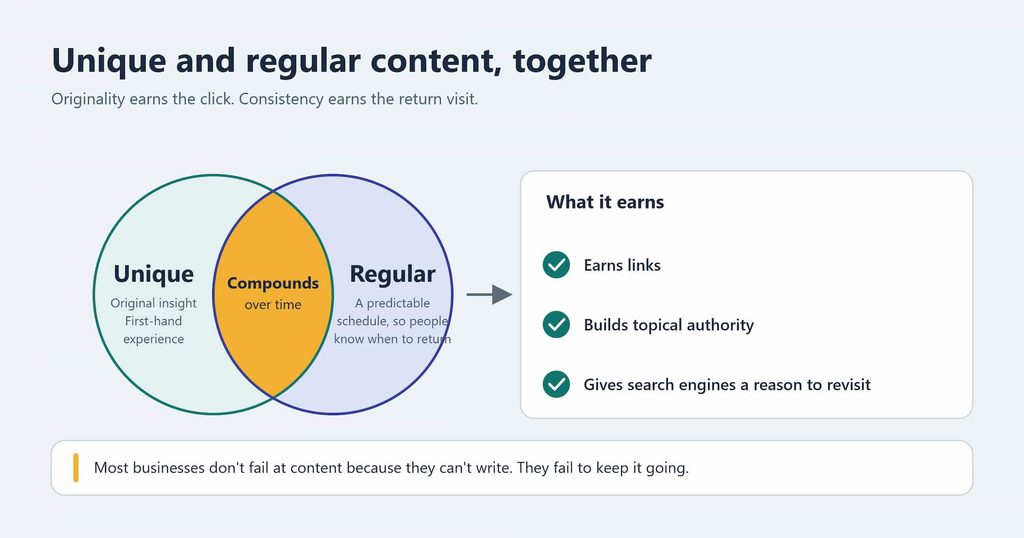
Two things drive content performance, and they reinforce each other. The first is originality. When every page on a topic says the same thing, there is no reason for a reader or a search engine to prefer one over another. The second is consistency. A single strong post is a spike; a steady stream of strong posts is a signal that a site is worth returning to and worth ranking.
Most businesses do not fail at content because they cannot write. They fail because they cannot keep producing engaging content on a regular basis and now with AI that predicts the next most probably word, we are seeing floods of the same content everywhere. The five formats below are designed to solve exactly that problem, each one giving you a repeatable source of original material rather than a blank page.
5 Ideas for Creating Unique and Regular Content
1. Ask Your Audience a Question
Posing a question directly to your audience, along the lines of “Have you ever…” or “What do you think of…”, turns your readers into a source of content. Their answers give you material you could not invent yourself, and the replies reveal the needs, objections, and language they actually use. A single well-chosen question can feed several later posts and sharpen the way you describe your own product. Use polls on socials to help garner community engagement and teach you gaps to fill, alternatively ask AI to impersonate your audience and ask it questions.
2. Publish Expert Advice with a Name Attached
An advice piece credited to a real specialist is original by definition, because no competitor can quote your expert. A skincare business, for example, can publish tips from an experienced dermatologist; a construction firm can publish guidance from a site foreman. The insight is not the point on its own, the credibility is. Attaching a named, qualified voice gives the content authority that a general article cannot claim.
3. Let Readers Ask the Questions
Extend the first idea by inviting your audience to send questions for a specialist or staff member to answer in a AMA style. This produces a recurring format you can run monthly, it guarantees you are addressing topics people genuinely care about, and it doubles as research into what your content should cover next and covers social channels for better brand entity coverage.
4. Interview Two People and Capture the Exchange
Bring two people together, write a short introduction explaining why they are there, and record the conversation. A discussion between a supplier and a customer, or two colleagues with opposing views, produces rich original material that reads differently from anything else on the topic. This format is industry dependent and will not suit every business, but where it fits it is hard to replicate. With AI dictation and transcript tools this is also easy to execute with a tool like Capcut or AnythingLLM.
5. Create Pictorial or Video Tutorials
If your business sells a physical product or a process, visual tutorials are one of the most effective forms of unique content. Interactive guides showing how to get the best from each item give buyers a reason to visit your site rather than a marketplace listing, and they are difficult for competitors to copy without the same product and the same expertise. Additionally in 2026 Google added Tiktok, Instagram, X and Youtube profiles to Google Search Console, indicating they are part of the wider brand entity Google considers for your rankings.
Choosing the Right Format for Your Business
Each format suits a different situation. Use the table below as a starting point.
| Format | Effort | Best for |
|---|---|---|
| Ask your audience | Low | Businesses with an active audience or social following can run regular polls |
| Expert advice piece | Medium | Services with qualified staff or partner specialists |
| Reader Q&A | Low, repeatable | Turning audience questions into a recurring series |
| Two-person interview | Medium | Industries where debates or pairings add value |
| Visual tutorial | High | Product and process businesses, query path aligned content |
Making It Regular, Not Just Unique
Originality solves the quality problem; a schedule solves the consistency problem. Build a simple plan: pick two formats from the table above, alternate them on a fixed cadence, and let the audience questions and expert conversations feed the calendar rather than starting from scratch each time. It is only as complicated as you make it. Keep a regular flow of interesting subjects going, and every now and then throw in something new, and the constant content problem largely disappears.
Turning Content Into Results
Regular, unique content compounds. It earns links, builds topical authority, and gives search engines a reason to revisit your site. If you would rather have a team run the process for you, our content marketing services and SEO services in Bangkok cover strategy, production, and measurement end to end.
Sign in to share. Facebook and LinkedIn need the article page to be publicly accessible to show its preview. If an AI cannot open the page, copy the article text from the section above.