

Choose an AI service. ChatGPT and Perplexity submit the summary request, Grok opens it ready to send, and other services open with the request copied as a fallback. If an AI cannot open the page, copy the article text and paste it into the chat.
AI has transformed content production. Blog posts can be drafted in minutes. Landing pages can be generated at scale. Keyword research and optimization are now built into everyday workflows. The barrier to creating content has never been lower.
But when everyone has access to the same tools, execution alone stops being an advantage.
The real shift is not that AI makes content easier. It’s that AI raises the baseline. Today, most businesses can produce technically sound, search-optimized, professionally written content. That level of quality used to differentiate brands. Now, it’s expected.
In our work with clients across Bangkok and Thailand, we’ve seen this change firsthand. Companies that once struggled to publish consistently are now producing content regularly. The challenge has moved. It’s no longer about publishing. It’s about standing out.
AI Raised the Baseline, Not the Advantage
AI-generated content today is coherent and structured. It follows SEO best practices. It covers topics thoroughly. In isolation, it looks impressive.
But when every competitor is doing the same thing, “good” becomes invisible.
There’s simply more content competing for the same attention. Users haven’t gained extra hours in the day. Search engines and AI systems still prioritize relevance and trust. As average quality rises, differentiation shrinks. What matters now isn’t whether your content is acceptable. It’s whether it sends a stronger signal than everyone else’s.
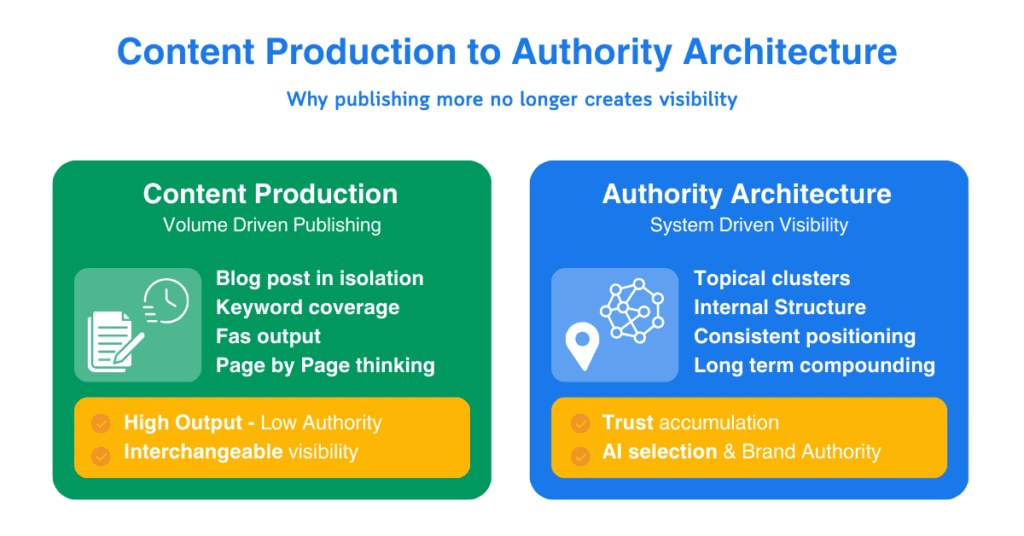
From Content Production to Authority Architecture
In an AI-driven search environment, visibility isn’t just about ranking. It’s about being selected.
According to Semrush’s AI SEO research, search engines and AI systems increasingly summarize and synthesize information instead of listing endless options. When they choose which brands to cite or surface, they look for patterns of authority. Not just one well-written article, but a consistent body of work that reinforces expertise.
We’ve seen this clearly with Thai businesses trying to scale content quickly. Publishing more pages doesn’t automatically improve visibility. What works is depth within a defined niche, consistent messaging, and a structured content strategy that builds on itself over time.
AI can speed up the writing process. It cannot design the long-term structure that builds authority.
The Risk of Interchangeability
The natural reaction to AI efficiency is to scale output. More blog posts. More landing pages. Broader keyword coverage. On paper, it looks like growth.
But without structure, it creates interchangeability.
When your content mirrors the same frameworks and angles used by dozens of competitors, it becomes replaceable. AI systems are designed to reduce uncertainty. If multiple sources look similar, they favor those with stronger accumulated trust signals.
Interchangeable content weakens brand positioning. It limits pricing power. It makes long-term visibility fragile.
The issue isn’t using AI. We use AI extensively at TBS Marketing. The issue is using it without a clear authority strategy behind it.
How AI Systems Evaluate Brand Credibility
AI-driven visibility depends on trust signals that machines can recognize, a standard formalized in Google’s E-E-A-T framework.
Is your brand consistently associated with a specific area of expertise
Does your website demonstrate topical depth rather than scattered themes
Is there a pattern of content that reinforces your positioning over time
These are not short-term tactics. They are cumulative effects. They require consistency and patience.
AI doesn’t remove the need for trust. It amplifies it.
Who Actually Stands Out?
In a world where tools are shared, advantage shifts to system design.
The brands that stand out are not those publishing the most frequently. They are the ones building structured authority. They define a clear territory and reinforce it consistently. They use AI to increase efficiency, but they don’t let it dilute their positioning.
Execution is now infrastructure. Strategy is leverage.
The companies that win understand that AI is not a shortcut to authority. It accelerates whatever foundation already exists. If the foundation is weak, AI scales noise. If the foundation is strong, AI compounds visibility.
Conclusion
AI hasn’t made content marketing obsolete. It has made generic content obsolete. To understand how AI Mode and ChatGPT are reshaping search, the rules of visibility have fundamentally changed.
When everyone can produce quickly, speed stops being rare. Coherence becomes rare. Depth becomes rare. Recognizable authority becomes rare.
The real question isn’t whether to use AI. It’s whether your brand is building a defensible authority system around it.
If you’re thinking beyond output and want to design a long-term content authority strategy that actually compounds, we’re always open to a conversation at TBS Marketing. Building visibility in the AI era isn’t about producing more. It’s about building smarter.
Sign in to share. Facebook and LinkedIn need the article page to be publicly accessible to show its preview. If an AI cannot open the page, copy the article text from the section above.